
Irvine Kitchen Hood Cleaning covers kitchen hood cleaning in Aliso Viejo, a weekday corporate-lunch market whose restaurant kitchens sit almost entirely inside a single town center. Aliso Viejo is one of the most concentrated markets in this service area, and that concentration is the defining feature of working here.
The overwhelming majority of the city’s restaurant kitchens sit inside a single town center rather than being spread along arterials or gathered in a historic downtown. One center, under common management, holds most of the commercial cooking in the city. That is unusual even among master-planned cities, and it changes how the work is organized.
Around it sits a different kind of demand entirely: corporate campus dining, a university, a hotel and a country club, all of which cook to a weekday or an event rhythm rather than a restaurant one. Those kitchens fill and empty on a calendar rather than on a dinner service.
One Center, Most of the Kitchens
Consolidation Under Common Management
When most of a city’s restaurants share a center, the center’s management becomes a significant party in how this work gets done. Access, staging, service hours and roof arrangements are all governed at that level rather than tenant by tenant. One conversation sets the terms for every kitchen in the building.
That is an advantage if it is used properly. A coordinated visit through several tenants in one night, agreed once with management, beats a dozen separate negotiations and produces far less disruption for everyone in the building. It also means the roof is opened once rather than repeatedly across a month. Roof access arrangements are usually the slowest part of any center visit to organize.
Shared Service Courts and a Shared Roof Plane
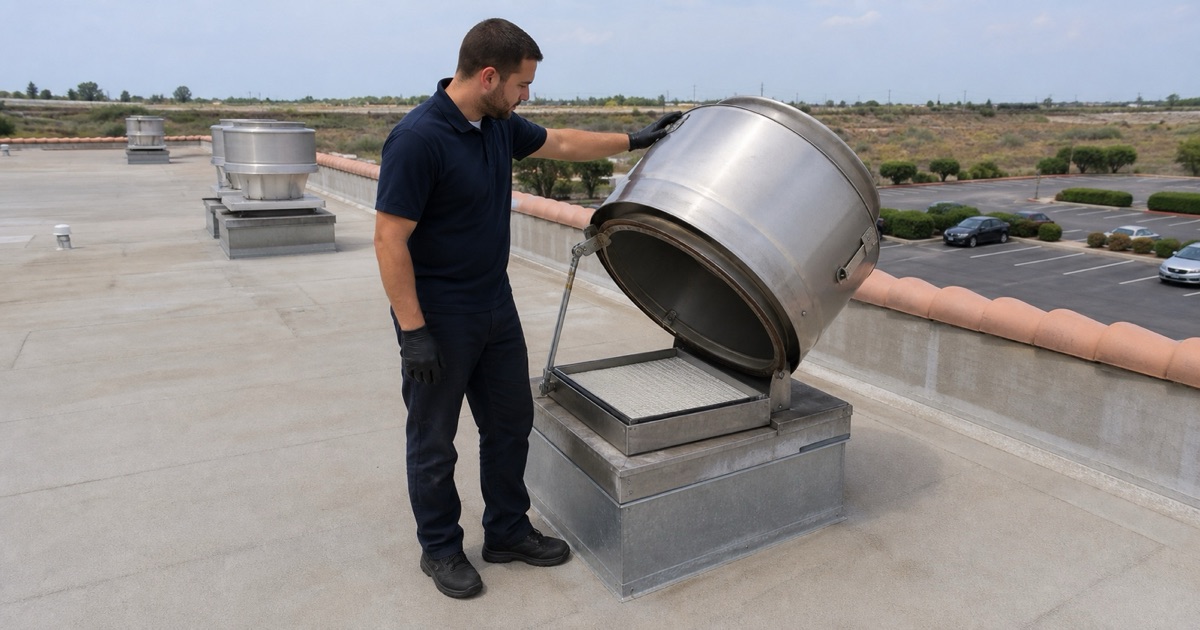
A town center built to one plan tends to share its back-of-house: common service courts, a continuous roof plane and rooftop equipment for multiple tenants in close proximity. That is straightforward to work on and easy to get wrong. Everything is reachable, which is precisely why nobody checks which unit they are standing on.
Fans sitting close together mean it matters which unit belongs to which tenant, and grease containment under one tenant’s fan does nothing for the one beside it. We identify the equipment against the unit rather than assuming from position. A fan two feet from a tenant’s back door frequently belongs to the unit beside it. Getting that wrong means cleaning somebody else’s equipment and billing the wrong tenant for it.
Tenant Turnover and Inherited Systems
Center retail turns over, and a new operator inherits whatever the previous one left in the ceiling. A kitchen can change hands twice without anybody opening the duct, and the incoming tenant has no way of knowing that. The previous operator’s paperwork rarely arrives with the keys. What does arrive is whatever was left in the ceiling, which nobody has photographed.
An inspection at handover establishes what condition the system is genuinely in and what it will cost to bring to a cleanable state. It is a small cost against a lease and it is the piece of due diligence nobody thinks of until afterward. Afterward it is the new tenant’s problem regardless of who created it.
Looking for kitchen hood cleaning closer to Laguna Hills? See Laguna Hills Kitchen Hood Cleaning.
Corporate Campus and Institutional Dining
Weekday Peaks and Quiet Weekends
Campus cafeterias in a business park cook hard from Monday to Friday and go quiet, which is a different loading pattern from a restaurant and a different scheduling opportunity. The service window is genuinely wide. A campus cafeteria closed from Friday evening is a straightforward job to plan around.
It also means the buyer is facilities management rather than a chef. What that buyer wants is an interval that holds without chasing, a current compliance file and a report written to survive an audit, and we produce records in that form as standard. Facilities buyers are also the ones most likely to actually read them. A report written for a chef and a report written for an auditor are different documents.
University and Institutional Kitchens
The city carries university dining alongside its corporate provision, and campus food service concentrates substantial volume into a small number of hoods. An academic calendar provides real windows for heavier work. Term breaks are when access panels and hinge kits should be fitted rather than squeezed into a night. Fitting them properly takes longer than the cleaning that follows, which is why the window matters.
Institutional kitchens also tend to keep records properly and to be asked for them, which makes the documentation half of this work more valuable here than in a market of small independents. Measured depth and photographs by area are what those files need. A record that cannot be filed is a record that will not be produced when it is wanted.
Hotel and Club Banquet Kitchens
Hotel and country club kitchens cook in bursts against an event calendar rather than continuously, and an averaged schedule misrepresents them in both directions. A fortnight of banquets is not the same as a fortnight of empty rooms. Averaging the two describes neither, and the risk sits entirely in the busy half.
We schedule against the calendar rather than a fixed cycle, and we band on what the line actually produces. That is the only way an event-driven kitchen ends up on an interval that reflects its risk. The calendar is available in advance, which makes this easier than it sounds.
Interval, Authority and Documentation
Banding on Cooking, Not on Setting
The California Fire Code bands cooking volume: monthly for solid fuel, quarterly for high-volume operations including charbroiling and wok cooking, semi-annually for moderate volume and annually for genuinely low-volume kitchens.
A master-planned city with a lot of casual dining still contains kitchens in several different bands. The center’s busiest restaurant and a quiet campus cafe do not belong on one schedule, and putting them there wastes money at one end and creates risk at the other. Both are avoidable with a measurement taken once, after which the interval argues itself from the record rather than from anybody’s assumption. Two or three cycles of readings settle it more convincingly than any discussion could.
Orange County Fire Authority as the Authority
Aliso Viejo is an OCFA member city, so plan review, inspection and the Guideline D-02 banding all run through that authority rather than a municipal department. That consistency is worth something in a service area where the fire authority changes from one city to the next.
Environmental health sits with Orange County Health Care Agency, which posts a pass or closure notification rather than a letter grade. Any argument built around protecting a grade is imported from another county and does not describe what happens here. It is worth noticing when a competitor’s copy has been written for somewhere else, because Orange County has never issued letter grades.
What the Report Has to Survive
The people who read these records are usually facilities managers, brand auditors, insurers or inspectors, and none of them were in the kitchen. The report is written for that reader deliberately, assuming no context the reader has to supply, which is what makes it useful rather than merely complete. A complete report nobody outside the kitchen can follow is a filing exercise rather than a record. Most of what we are asked to reissue is read by someone two roles removed from the person who booked the work.
Measured grease depth recorded as a number, photographs filed by area of the system, and anything that could not be reached named in writing with the reason. That combination is what turns a cleaning into a document somebody can rely on months later. Months later is when it is always read, and never before.
What the Report Has to Show
Photographs Filed by Area
Before, during and after photographs are organized by section of the system rather than presented as one flattering image, so the hood, plenum, duct and fan each carry their own evidence. A wide shot of a clean hood proves nothing about the run above it.
For a tenant inside a managed center, that structure also separates their system from the building’s. It is the difference between being able to answer an inspector directly and having to ask the center for paperwork.
Depth Measured at Defined Points
Grease depth is taken with a comb and recorded as a number, against roughly 2,000 micrometers as the point NFPA 96 treats as requiring cleaning and about 50 micrometers as what the work leaves behind.
That reading is what allows an interval to be argued from evidence. A kitchen convinced it needs quarterly attention and a kitchen convinced it needs none are both settled by the same measurement.
Exceptions Written Down
Anything that could not be reached is named with the reason, which NFPA 96 expects rather than leaving it out. In a center where runs travel through shared structure, that list is often where the real information is.
It also converts directly into work. A listed access panel fitted once removes a recurring exception permanently, which is a better outcome than the same line appearing on every report the tenancy produces.
- 20+ Years in Orange County
- Overnight & Between Services
- Photographed to Bare Metal










