
Irvine Kitchen Hood Cleaning can reach most of the kitchen hood cleaning in Brea on foot from one truck, because the city’s independent dining concentrates onto two adjoining downtown streets. Brea functions as a shopping and employment hub rather than a residential one, and its commercial kitchens reflect that: a compact downtown dining strip, a regional mall, and headquarters buildings with their own food service.
The downtown is unusually concentrated. A substantial share of the city’s independent dining sits on two adjoining streets, with several operators in a single address block. For a service that arrives with a truck and containment equipment, having that many kitchens within a short walk is a genuine planning advantage rather than a detail.
It shows up directly in what a coordinated visit costs each operator. Setup and containment are the expensive part, and they happen once.
The city also runs its own fire department rather than contracting with the county authority, which means plan review, suppression system permitting and inspection all go through a municipal department. That is worth establishing before anybody files paperwork addressed to the wrong body. It is a two-minute check that prevents an awkward conversation at an inspection. It also decides which department a suppression submittal goes to at fit-out.
Filing it with the wrong one costs weeks nobody planned for. On a fit-out schedule those weeks are the most expensive ones available. Rent runs whether the kitchen opens or not. Nobody refunds a delayed opening.
A Compact Downtown Dining Strip
Two Streets, Many Kitchens
The downtown dining district concentrates around two adjoining streets, with a number of restaurants sharing single address blocks. That density means several accounts can be serviced in one night with a single setup, and it means access arrangements agreed once benefit several operators.
We plan the district as a route rather than as unrelated appointments. Where several operators sit on similar intervals, sequencing them into one night costs each of them less than a separate mobilization would and disturbs the street once rather than repeatedly. Downtown businesses generally prefer one disrupted night to four quieter ones. A single agreed night is also easier for the city to live with.
Shared Buildings and Adjacent Tenants
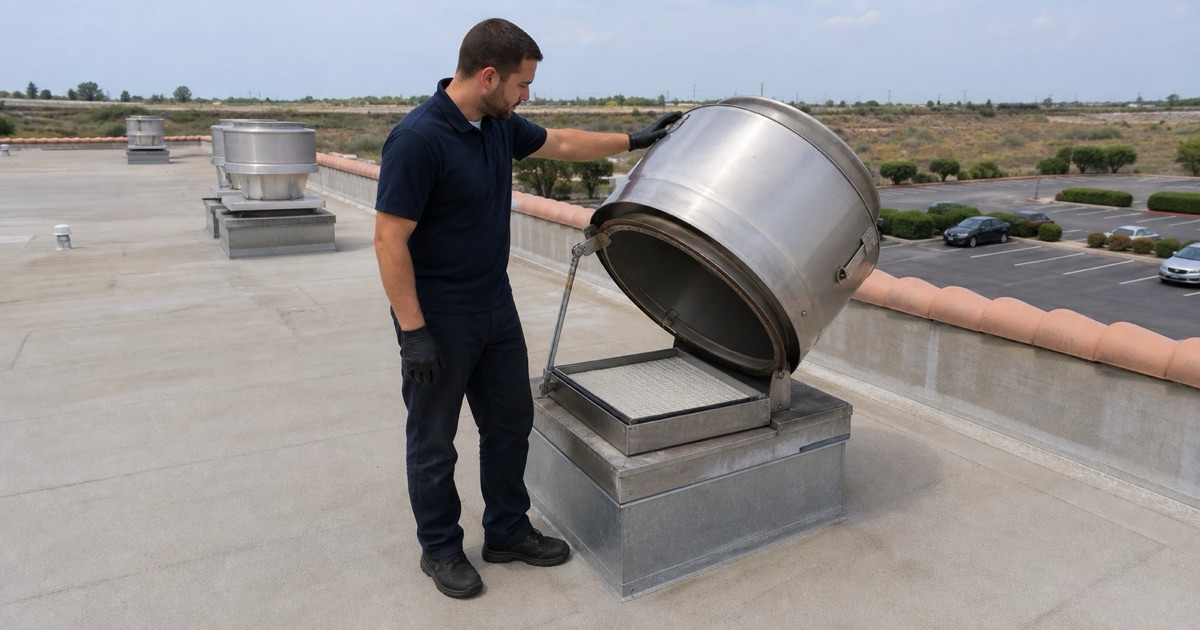
Restaurants sharing an address block frequently share structure, service access and sometimes a roof, and a crew working on one is working beside several others. Identifying which rooftop unit serves which tenant is a real step rather than an assumption.
We identify equipment against the unit rather than inferring from position, because on a shared roof plane a fan close to one back door regularly belongs to the unit beside it. Containment beneath each fan is checked separately rather than carried forward from a previous report. A pad serviced last visit tells you nothing about the unit next door. Each fan gets its own check and its own line in the report.
Evening Trade and Working Windows
A downtown dining district trades into the evening and reopens for lunch, which leaves a workable but not generous overnight window. Sizing the work to the window is part of quoting rather than something discovered once a crew is on site.
We agree the window with each operator before the quote goes out. Independent restaurants have very little capacity to absorb a lost service, so a plan that requires one is a plan most of them will decline whatever it costs. Sizing the work to the window is therefore part of the quote rather than an afterthought. A quote that ignores the window is really a quote for a different job.
Looking for kitchen hood cleaning closer to Seal Beach? See Kitchen Hood Cleaning in Seal Beach.
Corporate, Retail and Institutional Kitchens
Headquarters and Campus Dining
The city carries substantial corporate employment including headquarters buildings with their own dining facilities, some of them built to a genuinely commercial specification rather than as a canteen. Those kitchens peak Monday to Friday and go quiet, which is an unusually wide service window.
The buyer is facilities management rather than a chef, and what that buyer wants is an interval that holds without chasing, a current compliance file and a record that survives an audit. We supply documentation in that form as standard rather than on request. Facilities buyers are the readers most likely to actually open a report. They are also the ones who keep it for years rather than filing it and forgetting.
Regional Mall Food Service
The city’s regional mall carries food court and restaurant provision, which brings the usual multi-tenant considerations: shared infrastructure, center-controlled roof access and permitted working hours set by management rather than by any individual tenant.
We agree access once with center management and document tenant by tenant regardless of how the visit is coordinated. An individual operator has to be able to answer an inspector about their own system rather than about the building they happen to occupy. That distinction matters most at exactly the moment it is hardest to fix. An inspector standing in a kitchen will not wait while somebody emails the landlord.
Institutional and Community Kitchens
Alongside the commercial provision sit civic, community and institutional kitchens producing on a calendar rather than a daily service. Those are straightforward accounts with real service windows, and they benefit most from a schedule that somebody actually owns.
A community kitchen used heavily for a season and lightly otherwise is misrepresented by an averaged interval in both directions. We band on what the line actually produces and schedule against the calendar rather than against a fixed date. Community kitchens are among the easiest accounts to schedule well once somebody asks for the calendar. Very few contractors ask, which is why so many sit on arbitrary dates.
Interval and Measurement
Cooking Volume Sets the Band
The fire code bands by cooking volume — monthly for solid fuel, quarterly for high-volume operations including charbroiling, semi-annually for moderate volume, annually for genuinely low-volume kitchens. Seat count, floor area and menu length decide none of it.
Two restaurants of similar size on the same street can belong in different bands if one runs a grill through every service and the other does not. We measure grease depth rather than estimating from the hood face and band each kitchen individually. The hood is frequently the least informative part of a system to judge by eye. What matters is what the duct behind it is carrying.
Where a Default Interval Goes Wrong
A flat semi-annual cycle applied across a district is a scheduling convenience rather than a code position, and it errs in both directions at once. A heavy line loads well inside it, while a light kitchen pays for work its cooking has not earned.
Neither is discovered without measurement, and neither is corrected by a contractor whose schedule was set at the start of a contract and never revisited. We re-band when a kitchen changes rather than waiting to be told about it. Operators rarely think to mention a new appliance, which is fair enough. Asking at each visit takes a moment and catches it before an inspector does.
Reading a Record Across Visits
A single measurement establishes a position; a series establishes a direction. A depth climbing steadily between visits says the interval is wrong long before an inspector does, and it says so in a form nobody has to take on trust.
That is the whole argument for recording numbers rather than adjectives. Three visits of measurements tell an operator whether their schedule is right, while three visits of “system cleaned” tell them only that somebody attended.
Authority, Records and Handling
A City Fire Department, Not the County Authority
Brea runs its own fire department, so plan review, suppression system permitting and inspection go through the city rather than the county authority that serves many neighboring jurisdictions. Records are written to be read by that department.
The city sits close to the county line, which occasionally causes confusion about which county’s rules apply. Brea is in Orange County, and environmental health sits with Orange County Health Care Agency, which posts a pass or closure notification rather than a letter card.
What Each Visit Leaves Behind
Every cleaning produces measured grease depth as a number, photographs filed by area of the system, and a written list of anything that could not be reached with the reason. Those are the three things a later reader can actually use.
We keep every report and reissue it on request. The request typically arrives from an inspector, a carrier or an incoming owner months later, at the point where reconstructing the history from anybody’s memory is no longer possible.
Grease, Wastewater and Capture at Source
Fats, oils and grease requirements here run through the city under its own wastewater discharge permitting rather than through a separate district. That is a simpler arrangement than several nearby jurisdictions carry and worth confirming from the address.
Wash water and degreaser are captured rather than sent toward a floor drain, both because that is correct handling and because everything reaching a drain line ends up in the grease interceptor and brings its next pumping forward at the operator’s expense.
- 20+ Years in Orange County
- Overnight & Between Services
- Photographed to Bare Metal










