
Irvine Kitchen Hood Cleaning maps kitchen hood cleaning in Buena Park before quoting it, because the venue production kitchens and multi-level food center here run duct in ways an ordinary restaurant does not. Buena Park carries a concentration of visitor-driven food service unlike anywhere else in north Orange County, and the kitchens behind it are not ordinary restaurant kitchens.
A theme park drawing millions of visitors a year, dinner theaters producing hundreds of covers to a fixed performance schedule, and a large multi-level Korean food center between them add up to a market defined by production cooking rather than table service. Those kitchens cook to a schedule set by a show or a gate rather than by a dinner rush. That makes them predictable, which is an advantage once the calendar is known. A kitchen that produces to a published schedule can be banded and booked months ahead, which is rare in this trade and worth using.
Predictable loading is far easier to schedule against than an irregular restaurant trade. The calendar does most of the planning for us. One landlord relationship covers what would otherwise be a dozen separate negotiations.
The multi-level food center adds a technical dimension most cities do not have. Where a food hall occupies three floors, duct runs climb between them toward a shared roof, and a vertical run holds a large share of a system’s total deposit while being the hardest part of it to reach. It is also the part nobody can see from any floor of the building. Tenants judge their system by the hood in front of them, and the section carrying most of the risk is several floors above their ceiling.
Nothing about a riser is visible from inside a tenant’s unit. Tenants are frequently surprised to learn how far their duct actually travels. Charcoal and high-heat cooking move a kitchen up the table regardless of its size.
Production Kitchens on a Fixed Schedule
Cooking to a Performance Rather Than a Service
A dinner theater produces several hundred covers simultaneously to a curtain time, then stops entirely. That is production cooking rather than à la carte service, and it loads an exhaust system in a concentrated burst rather than across an evening.
Those kitchens also have immovable schedules. A venue cannot move a performance to suit a contractor and should not be asked to, so the working window is fixed and the plan has to arrive with the quote rather than after it. Venues remember which contractors understood that and which had to be told.
Working to a fixed schedule reliably is most of what a venue account is. The technical side rarely causes difficulty; the timing always can.
Theme Park and Gate-Driven Food Service
A large theme park operates numerous food outlets across a site, with volume driven by the gate and a strong seasonal profile. That is many systems under one operator rather than one large kitchen, and the coordination matters more than any individual cleaning.
We plan across the site rather than per outlet, sequencing so that no two outlets needed for the same period are offline together. On an account of that size the scheduling is most of the work and the cleaning is the straightforward part. Getting the order right is what the operator is actually buying.
The cleaning itself is a commodity; the sequencing is not. That is where the value of a multi-outlet account actually sits. The riser is where the fire risk concentrates and where nobody has ever looked.
Seasonal Peaks and Event Periods
Visitor-driven food service peaks hard around holidays and event seasons, and an averaged annual schedule describes neither the peak nor the quiet period accurately. A month of heavy operation is nothing like a month of reduced hours.
We schedule against the operating calendar rather than a fixed date. Cleaning immediately ahead of a heavy season is worth considerably more than cleaning partway through one, and those calendars are known well in advance. A season that starts with clean systems is a season that finishes without a correction notice.
Looking for kitchen hood cleaning closer to Los Alamitos? See Los Alamitos Kitchen Hood Cleaning. Establishing that before the season starts is worth more than establishing it during one.
Multi-Level Food Service and Vertical Runs
Duct That Climbs Between Floors
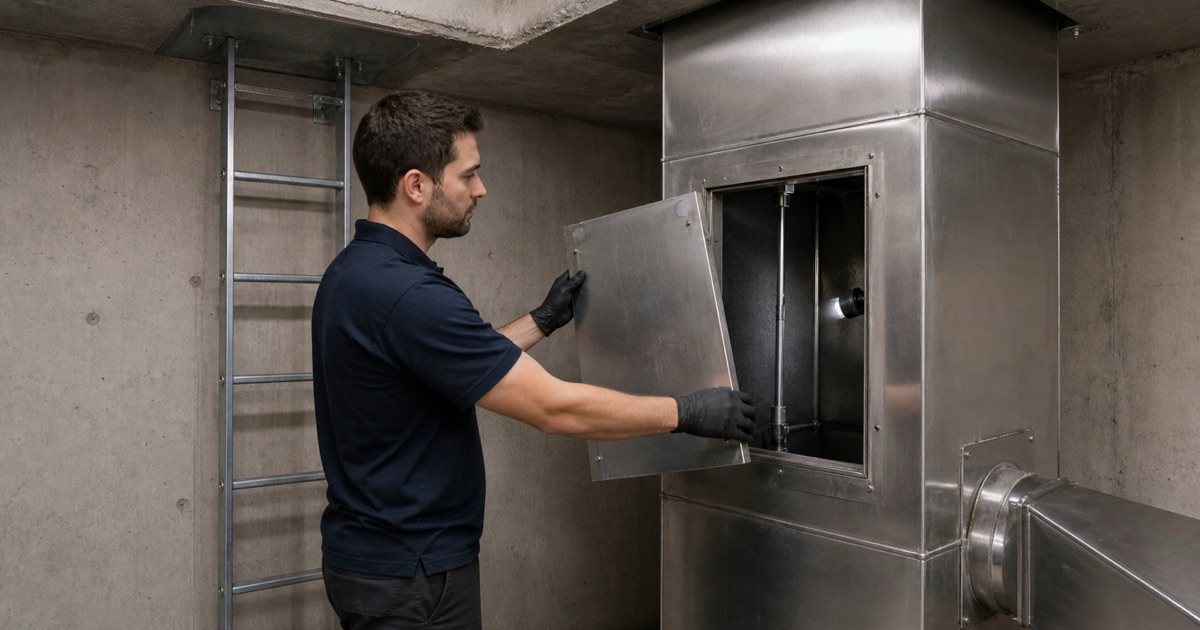
A three-story food center means exhaust runs that travel vertically toward a shared roof rather than straight out of a single-story building. A riser of that kind holds a substantial share of the system’s deposit and is the section least likely to have been opened.
We map the run before quoting rather than assuming from the hood, because the number and position of access openings along a vertical run decides what can genuinely be cleaned. Where they are absent, that section goes on the exceptions report with the reason. A riser with no openings is the single most common serious finding in multi-level buildings.
It is also the one most likely to have gone unreported by a previous contractor. Reporting it honestly is the first thing a new contractor can do that matters.
Many Small Tenants Under One Roof
A large food center puts a considerable number of independent kitchens inside one building, each with its own obligation regardless of how the leases are drawn. Several may sit in different frequency bands depending on what they cook.
The efficient arrangement is a coordinated visit agreed with center management and worked through in sequence, documented tenant by tenant. A building-wide report is useless to an individual operator being asked about their own kitchen by an inspector. Coordination and documentation are separate questions and both need answering.
Getting one right and the other wrong leaves a tenant no better off. Both are part of what a coordinated visit should deliver. That documentation is what an operator produces when an inspector asks rather than what they promise.
Shared Structure and Common Sections
In a multi-level building it is not always obvious where one tenant’s system ends and common infrastructure begins, and tenants frequently have no idea what happens above their ceiling. Those boundaries are best settled before a cleaning rather than during an invoice discussion.
We establish the route of each system and name any genuinely common sections. A common run needs an owner identified before anybody can reasonably be billed for it, and that is a conversation for the landlord rather than for a tenant. Settling it before the work avoids an argument about the invoice afterwards.
Corridor Restaurants and Retail Dining
The Entertainment Corridor
The city’s main commercial corridor carries substantial visitor-oriented dining alongside the venues, running long hours through peak season with kitchens that close briefly rather than for long. That compresses the working window without reducing the scope.
We work overnight and between services and agree the real window before quoting. In a visitor economy the opening hours run longer than operators outside one tend to expect, and a plan built on a normal closing time will not survive a season. Peak-season hours and off-season hours are frequently different, which matters too.
Mall and Center Food Service
The city’s retail centers carry their own restaurant and food court provision with the usual multi-tenant considerations: center-controlled roof access, permitted working hours set by management, and equipment for several units close together on a shared plane.
We agree access once with management, identify equipment against each unit rather than inferring from position, and check containment beneath each fan separately. A serviced containment box under one discharge tells you nothing about the fan beside it. On a busy center roof that is an easy assumption to make and an expensive one. Equipment gets added, replaced and relocated over the life of a center, and nothing on the roof records which unit any of it was installed to serve.
Independent Restaurants Beyond the Corridor
Away from the visitor economy the city carries neighborhood restaurants in ordinary retail centers, including a substantial Korean dining sector. High-heat and charcoal cooking sit in shorter bands than a casual format, which is a technical fact rather than a description.
We band each kitchen on the equipment that actually runs. Two units in the same center can genuinely belong on different schedules, and applying a center-wide interval for convenience is wrong for most of the tenants in it. Charcoal and high-heat cooking sit well up the table regardless of unit size.
A small unit running charcoal outranks a large one that does not. Equipment decides the band; square footage never has. A venue calendar is published far enough ahead to plan a whole year of visits against.
Authority, Interval and Wastewater
Orange County Fire Authority
Buena Park is an OCFA member city, so plan review, inspection and the Guideline D-02 frequency banding run through that authority rather than a municipal department. Records are written to be read by OCFA.
Environmental health sits with Orange County Health Care Agency, which posts a pass or closure notification rather than an A, B or C card. The two authorities ask different questions about the same kitchen, so the paperwork addresses both.
Banding Very Different Kitchens
The bands run from monthly for solid fuel through quarterly for high-volume operations including charbroiling and wok cooking, to semi-annually for moderate volume and annually for genuinely low-volume kitchens. This city populates most of that range.
A dinner theater production kitchen, a food court unit and a neighborhood restaurant have almost nothing in common beyond the code that governs them. We measure and band each one rather than applying an interval across an account. One schedule for all three would be wrong for at least two of them.
Grease Interceptors and Service Frequency
The city sets its own expectations for how often grease traps and interceptors are serviced, and those are separate obligations from the exhaust side rather than part of it. Confusing the two is common and worth clearing up early.
Wash water and degreaser are captured at source rather than sent toward a floor drain. On a high-output production kitchen that matters more than usual, because everything reaching the drain line brings the next interceptor service forward at the operator’s expense. On a venue account that cost is meaningful rather than incidental.
- 20+ Years in Orange County
- Overnight & Between Services
- Photographed to Bare Metal










