
Irvine Kitchen Hood Cleaning provides commercial kitchen exhaust cleaning in Irvine, CA and across the surrounding cities including Tustin, Lake Forest, Aliso Viejo, Laguna Hills and North Tustin. The scope is the complete exhaust path that a Type I hood serves: filters, hood interior, plenum, horizontal duct, vertical riser, and the rooftop fan that finally discharges it above the building.
“Hood cleaning” and “exhaust cleaning” get used interchangeably in this trade, and the difference is worth holding onto. A hood is the part a customer can see, touch and form an opinion about. The exhaust system is everything the grease-laden vapor travels through afterward, and it is where a fire actually propagates once one starts. Buying the first and believing you have bought the second is the most expensive misunderstanding available in this category.
This page is written for the buildings where a kitchen is one system among many — hotels, hospitals, university and district dining, food halls and business-park cafeterias. Those buyers need documentation as much as they need cleaning, usually in a form that a facilities file can absorb and a vendor-compliance audit can survive without anybody having to remember the visit.
The Full Exhaust Path, Not the Visible End
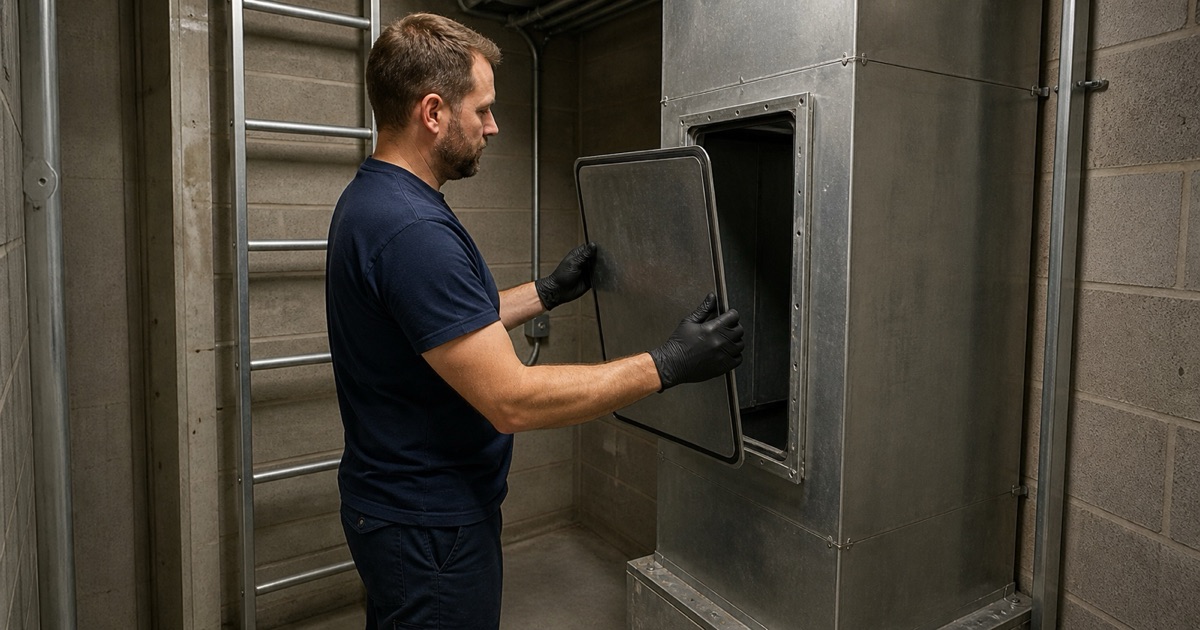
Type I Systems and What They Serve
A Type I hood is listed for grease-laden vapor and is the one this work applies to, while a Type II hood handles heat and steam only and carries an entirely different obligation. Knowing which you actually have decides whether this service is required at all, and it is not always obvious from the equipment sitting underneath it. We identify the listing rather than inferring it, because selling a compliance cleaning against a hood that never needed one is its own kind of failure.
Duct Runs, Risers and Access Points
A long horizontal run above a ceiling, or a riser climbing several floors inside a shaft, gets cleaned through access openings along its length. Where those openings do not exist, the run cannot be cleaned and cannot honestly be certified as clean, whatever a tag says. We map which sections are genuinely reachable before quoting, so the limits of the work are established at the start rather than discovered by an inspector later. Adding panels where they are missing is a separate quote and usually a one-off.
Discharge, Curb and Containment
At the top of the system the fan and its curb are cleaned and the rooftop containment is serviced. Grease that leaves the discharge and settles onto a single-ply membrane is a building problem rather than a kitchen one, and it commonly voids a roofing warranty outright, which puts the exposure on the owner rather than the tenant who cooked. We photograph roof condition around the fan so that conversation can be had from evidence instead of from assertion.
Documentation Built for a Facilities File
Measured Grease Depth
Depth is measured with a comb and recorded as a number rather than described in adjectives. NFPA 96 uses roughly 2,000 micrometers as the threshold at which cleaning becomes required, and about 50 micrometers as the standard the cleaning works down toward. Numbers let a facilities manager compare this visit against the last one, and one site against another, without having attended either — which is the only way portfolio oversight actually functions.
Photographs Filed by Area
Before, during and after photographs are organized by section of the system, so the hood, plenum, duct and fan each carry their own evidence rather than sharing one image between them. That structure exists because a single wide photograph of a clean hood tells a reviewer nothing whatsoever about a riser. It also survives being forwarded to somebody who has never set foot in the kitchen, which is usually who ends up looking at it.
The Exceptions Report
Anything that could not be cleaned is named in writing together with the reason. NFPA 96 expects that report rather than a quiet omission, and it is the document that converts an inaccessible duct run into a scheduled repair with a price against it. Across a multi-site portfolio it is also how a facilities team discovers which of its kitchens has a structural problem rather than a housekeeping one, which is a different budget and a different conversation.
Multi-Site, Multi-Tenant and Shared Systems
Food Halls and Shared Envelopes
A food hall puts many small kitchens inside a single building envelope, sometimes with duct runs climbing several floors toward a shared roof. Center management is usually the real decision-maker rather than any individual tenant, and the tenants themselves often have no idea what happens above their ceiling. We coordinate the visit across tenants so the work happens once rather than as a dozen uncoordinated appointments, and we document by tenant so responsibility stays legible after the leases turn over.
Institutional Kitchens That Never Close
Hospital kitchens and 24-hour cafeterias have no closing time to work behind, so the work gets sequenced in sections against the meal schedule instead of done in a single pass. Continuing-care dining rooms carry the same constraint with an additional one on top: residents cannot simply skip a meal while a kitchen is offline. We stage those room by room and agree the order in advance rather than improvising it on the night.
Corporate and Campus Accounts
Campus and business-park cafeterias are bought through facilities management rather than by a chef, and that changes what the buyer actually wants from a vendor. The priorities become an interval that holds without chasing, a vendor-compliance file that is current, and a record written to survive an audit. We supply the documentation in that form rather than as a receipt taped inside a cabinet door, because the second one is worth nothing the day somebody asks.
Compliance, Written the Way the Code Reads
Inspection Interval Versus Cleaning Trigger
California Fire Code Table 606.3.3.1 sets an inspection frequency, and Section 606.3.3.2 requires cleaning when that inspection finds contamination, performed in accordance with ANSI/IKECA C10. Nearly every competitor writes this as a flat cleaning mandate, and that is simply not what the code says. Understanding the distinction frequently changes what an account ought to be paying, in both directions, and it is the first thing we go through on a new site.
Knowing Which Authority Reads It
Orange County Fire Authority serves Irvine, twenty-two other member cities and unincorporated county under Guideline D-02, but several cities in this service area run their own fire departments with their own submittal requirements and their own paperwork. Records are written for the authority that will actually read them, which is not something an out-of-area contractor tends to get right, and not something you want discovered during an inspection.
Tags, Records and Retention
The service tag records who cleaned the system, when, and what was left uncleaned, and prior tags are covered or removed so the current one is unambiguous. We retain the full report and reissue it on request for as long as you are an account. The request almost always arrives after a claim, an inspection or a change of ownership, at exactly the point where reconstructing the history from memory is no longer possible.
- 20+ Years in Orange County
- Overnight & Between Services
- Photographed to Bare Metal