
Irvine Kitchen Hood Cleaning treats kitchen exhaust cleaning in Costa Mesa as work above occupied retail, since a large share of the city’s restaurant kitchens vent through the roof of a trading super-regional mall. Costa Mesa carries the densest concentration of full-service restaurant cooking in this service area, and a large share of it sits inside one enclosed retail property.
That changes the job in a specific way. Rooftop work above an enclosed mall is work above occupied selling floor, with people and stock underneath rather than an empty structure. Everything about staging, containment and timing follows from that, and none of it applies to a freestanding restaurant on a pad. The building underneath is the constraint, not the kitchen above it.
Occupied retail changes the setup, the containment and the hours available. It also changes who has to approve the work before it starts. Center operations, not the restaurant, hold the roof access and set the hours. That is worth knowing before promising a tenant a date.
The city also carries a large event and fairground operation whose kitchens surge for a defined period and then stop, which is a loading pattern that a fixed annual schedule describes badly in both directions.
Restaurant Kitchens Inside an Enclosed Center
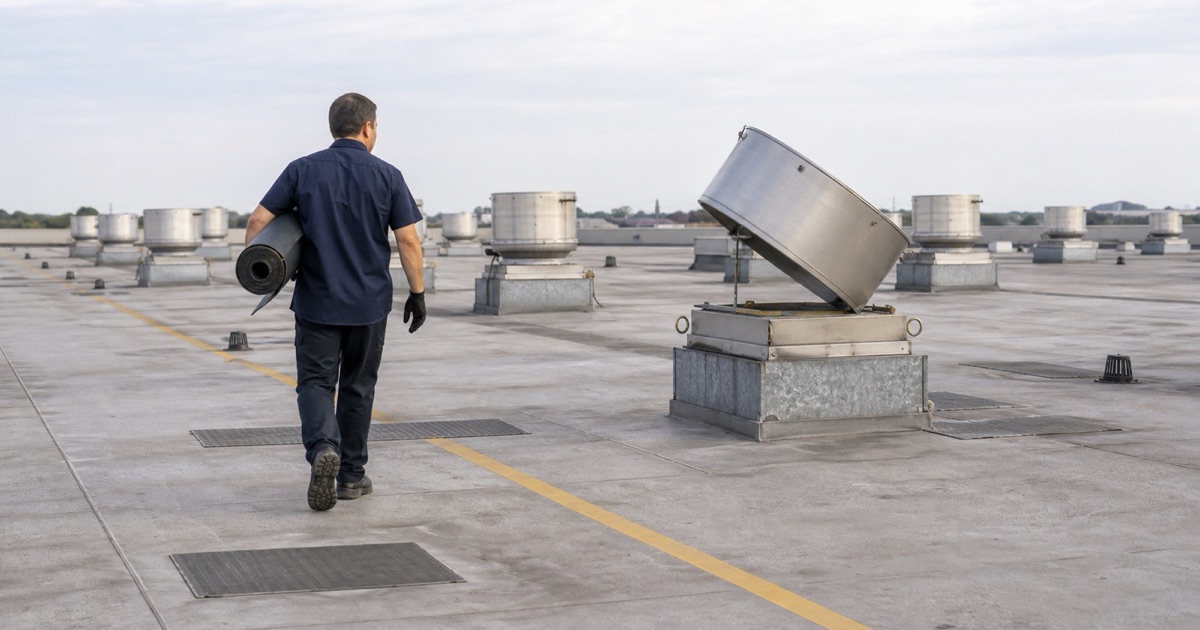
Working Above an Occupied Selling Floor
South Coast Plaza runs to roughly 2.8 million square feet with more than thirty distinct eateries, and the roof over those kitchens is also the roof over trading retail. A dropped tool, a spill or an uncontained wash is a different order of problem there than it is on a standalone building.
Containment goes in before anything moves, and wash water is captured rather than allowed to find its own way. We stage and work to the center’s requirements rather than our own convenience, because access to that roof is granted rather than assumed. Losing roof access on a center of that size is not a recoverable mistake. Management grants it on the understanding that it will not become a problem.
High-Output Lines and What They Produce
Full-service restaurant kitchens at this end of the market run longer services and heavier lines than casual formats, and several of them cook at a level that puts real volume through a hood. Output rather than seat count is what decides the band.
We measure grease depth and set the interval from the reading. A kitchen with a modest dining room and a hard-working line frequently needs more attention than a larger room with a simpler menu, and only a measurement separates the two reliably. Appearances are a poor guide in a market with this range in it. The county’s most demanding lines sit here alongside straightforward casual formats.
Coordinating Across Tenants and Management
A center with dozens of food tenants cannot sensibly be serviced as dozens of unrelated appointments, each negotiating roof access separately. The efficient arrangement is coordinated visits agreed with center management and worked through in sequence.
We document tenant by tenant even when the visit is coordinated, because an individual operator needs to be able to answer an inspector about their own system. Coordination is about how the work happens, not about whose record it is. A report covering a building tells them nothing they can use and nothing they can hand over.
Looking for kitchen hood cleaning closer to Mission Viejo? See Mission Viejo Kitchen Hood Cleaning.
Event and Venue Kitchens
Cooking That Surges and Then Stops
The city’s fairground and event operations run kitchens hard for a defined season and then leave them idle, which is a pattern an averaged schedule misrepresents at both ends. A three-week run of heavy service is not the same as three weeks of an empty building.
We schedule against the calendar rather than a fixed date, because cleaning immediately before a heavy season is worth considerably more than cleaning in the middle of one. The calendar is published well in advance, which makes this easier to plan than it sounds. Working to a season is straightforward once somebody agrees to look at it.
Temporary and Seasonal Cooking Equipment
Event operations frequently bring in cooking equipment that is not part of a permanent installation, and the exhaust arrangements around it vary in quality. What is straightforward in a purpose-built kitchen becomes a question worth asking on a site that changes configuration between seasons.
We look at what is actually installed rather than what the drawings show. Where an arrangement is temporary, the relevant question is whether it can be cleaned and documented at all, and that is better answered before a season than during one. A system nobody can open is a problem whichever season it is.
Performance and Cultural Venue Dining
The city’s performing arts and cultural venues carry their own food service on an event calendar, cooking to a curtain rather than to a lunch rush. Those kitchens have narrow, well-defined windows and a hard stop.
Working to that kind of schedule is straightforward once it is agreed and impossible if it is not. We take the calendar first and build the work around it, rather than proposing a date and asking a venue to accommodate it. Venues cannot move a performance to suit a contractor and should not be asked to.
Authority, Utilities and Records
A City Fire Department Rather Than the County Authority
Costa Mesa runs its own fire department rather than contracting with the county authority, so plan review, inspection and hood system permitting go through the city. That is not the arrangement in every neighboring city and it is worth naming correctly.
Records are written to be read by that department. A report referencing a county authority with no jurisdiction over the property is the kind of small error that invites a second question during an inspection. Second questions are how short inspections become long ones.
An Independent Sanitary District
Wastewater and grease requirements here run through an independent sanitary district rather than through the city, which surprises operators who assume the two go together. Fats, oils and grease obligations come from that district.
We capture wash water and degreaser rather than sending it toward a floor drain, both because it is the correct handling and because an interceptor receiving everything a cleaning produces needs pumping sooner at the operator’s expense. That cost is invisible on the night and obvious two months later.
What the Report Has to Carry
Every visit produces measured grease depth recorded as a number, photographs filed by area of the system, and a written list of anything that could not be reached with the reason. Those three things answer nearly every question anybody later asks about a kitchen.
For tenants inside a managed center that documentation does a second job. It separates the tenant’s own system from the building’s, which is the difference between answering an inspector directly and having to go and ask somebody else for paperwork. In a center of that size, asking somebody else takes days.
Setting the Interval From Evidence
Cooking Volume Rather Than Seat Count
The California Fire Code bands by cooking volume — monthly for solid fuel, quarterly for high-volume operations including charbroiling, semi-annually for moderate volume and annually for genuinely low-volume kitchens. Seat count and menu length decide none of it.
A full-service room with a hard-working line and a large casual restaurant with a simple menu can sit in different bands entirely. The band follows the equipment and the hours it runs. Neither of those is visible from the dining room, which is where most estimates get made.
Walking the line takes a few minutes and removes the guesswork. It is also when solid fuel gets discovered, which changes the band entirely. We measure and band each kitchen rather than applying one interval across a center, because a single schedule for thirty tenants is wrong for most of them.
Measured Depth as the Record
Grease depth is measured with a comb at defined points and recorded as a number, against roughly 2,000 micrometers as the point NFPA 96 treats as requiring cleaning and about 50 micrometers as what the work leaves behind.
Those readings are what make a cleaning history informative rather than decorative. Three visits of measurements tell an operator whether their interval is right; three visits of “system cleaned” tell them only that somebody turned up. The second kind of record is common and close to worthless.
Exceptions and What They Cost to Close
Anything not reached is named in writing with the reason, which is what the standard expects. Inside a mall, where runs travel through shared structure toward a common roof, that list is frequently where the useful information is.
Most exceptions resolve to listed access panels quoted separately. Weighed against the same line appearing on every report for the life of a tenancy, closing one permanently is rarely a difficult decision once it has been priced. Most operators decide within a visit of seeing the number.
Until it is priced, it stays an annoyance rather than a decision. Pricing it is part of the report rather than a separate exercise, so the choice is available immediately. Most of these items are small next to the value of closing them permanently.
- 20+ Years in Orange County
- Overnight & Between Services
- Photographed to Bare Metal










