
Irvine Kitchen Hood Cleaning cleans rooftop kitchen exhaust fans in Irvine, CA and the surrounding cities including Tustin, Orange, Santa Ana, Costa Mesa and Garden Grove. The fan is the end of the system, the least visited part of it, and the place where a neglected exhaust run finally shows what it has been carrying.
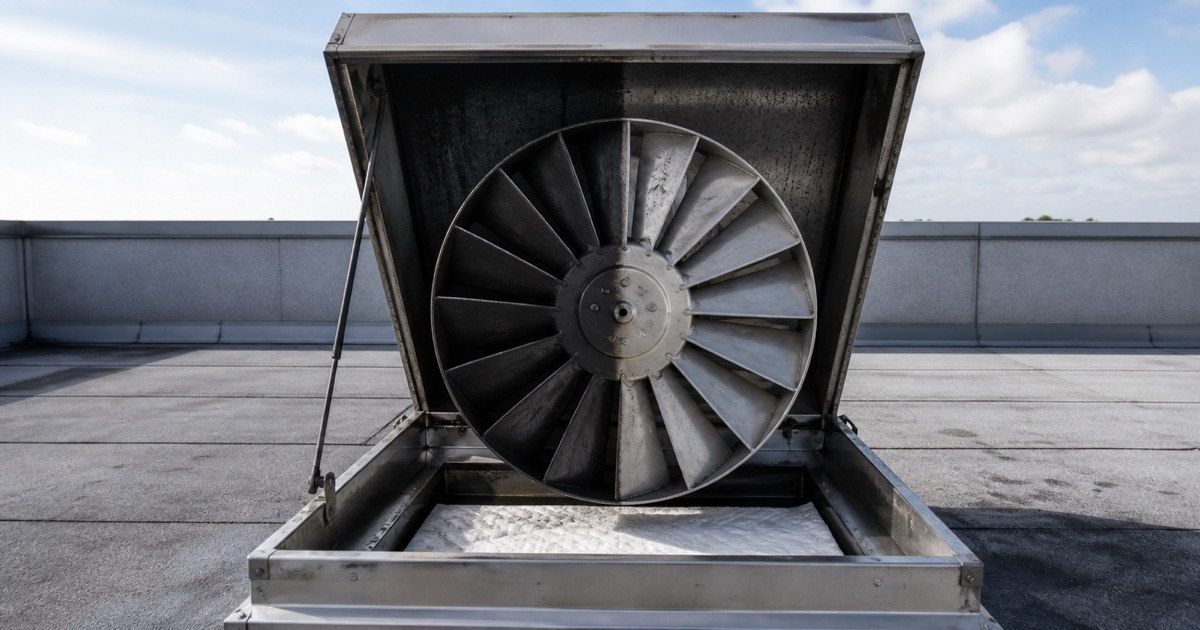
Cleaning a fan properly means lifting it. An upblast fan tilts back on a hinge kit so the wheel, the housing interior and the curb beneath can be reached, and a fan that is never lifted is never cleaned no matter what appears on the invoice. That is the single thing most worth checking about any exhaust cleaning you have paid for.
Fans also fail slowly rather than suddenly, and the decline is gradual enough that a kitchen adapts to it without ever registering a problem. By the time somebody calls, the crew is usually dealing with a wheel that has been out of balance for a year and bearings that have paid for it.
What Cleaning the Fan Involves
Lifting the Fan Correctly
The fan is tilted back on its hinge kit and rested on a hold-open retainer so it cannot come down while anybody is working underneath it. Where a flexible weatherproof service cable is fitted, the fan opens without dragging on its own wiring. If the hinge hardware is missing or seized we will tell you, because that fan cannot be cleaned underneath until it is put right, and no honest report can describe it as clean in the meantime.
The Wheel, Housing and Discharge
The wheel is cleaned on both faces and between the blades, which is where deposits build unevenly and throw it out of balance. The housing interior and the discharge are cleaned at the same time. A loaded wheel costs airflow, wears bearings early and sounds like a failing motor, so this is as much a mechanical service as a hygiene one.
The Curb and What Has Pooled There
The curb underneath is usually where the heaviest single deposit in the building has collected, because everything that condenses in the fan eventually runs down. It is cleaned, and the condition of the roof surface around it is photographed. On a system that has gone years without the fan being lifted, this is the part that surprises people, and it is usually the moment a building owner starts asking who has been signing off the previous cleanings.
Containment and the Roof Underneath
Grease Containment Boxes and Pads
Containment sits under the discharge to catch what the system throws out, and it only works while the absorbent pads have capacity. Saturated pads are doing nothing except creating the appearance of management. We check and service containment on every visit and replace pads as consumables rather than treating them as permanent fixtures.
Roof Membrane and Warranty Exposure
Grease degrades single-ply roof membranes and commonly voids roofing warranties, and that exposure normally sits with the building owner rather than the tenant whose kitchen produced it. We photograph the roof condition around the fan on every visit so the question can be settled from dated evidence instead of argued from recollection between a landlord and a tenant.
Access, Safety and Staging
Roof access varies enormously across this service area, from a straightforward ladder to a hatch with restricted hours to a center where staging has to be arranged with management in advance. We establish access before quoting rather than discovering it on the night. Where a roof is sloped or the fan sits awkwardly, that changes the crew and the timing rather than the scope.
What a Neglected Fan Costs
Airflow and Capture at the Hood
A loaded wheel moves less air, and the loss shows up at the other end of the system as a hood that no longer captures cleanly over the busiest part of the line. Kitchens usually blame the hood, or the make-up air, or the weather. The wheel is where the airflow actually went, and it is the cheapest of those explanations to test.
Bearings, Belts and Premature Wear
An unbalanced wheel puts a load on bearings they were never specified to carry, and belts glaze and slip against the extra resistance. A fan cleaned on a sensible cycle is a fan whose wear items reach their designed life. One that is never lifted converts a cleaning problem into a mechanical one, and mechanical parts cost several times what the cleaning would have.
Fire Load at the Discharge
The fan and the curb beneath it hold the heaviest single deposit in many buildings, sitting directly above a roof and directly downstream of everything the duct carries. That is the part of the system furthest from anybody’s attention and closest to a genuine ignition risk. Cleaning it is the reason the scope ends at the fan rather than at the roof hatch.
- 20+ Years in Orange County
- Overnight & Between Services
- Photographed to Bare Metal