
Irvine Kitchen Hood Cleaning describes kitchen hood cleaning in Fountain Valley accurately rather than generically: this city has two acute-care hospital kitchens, corporate headquarters dining, and no restaurant district at all. This is an unusual market and it is worth describing accurately rather than generically, because Fountain Valley does not have the thing most cities of its size have. There is no mall, no food hall, no restaurant row and no designated dining district here.
What it has instead is institutional weight. Two acute-care hospitals are the city’s largest employers, and around them sit corporate headquarters, business parks and a golf and recreation base that between them account for most of the commercial cooking in the city. That is a genuinely different buyer from a restaurant operator, and it wants genuinely different things from a service contractor.
We say that plainly because a contractor who arrives expecting a dining scene will quote for the wrong market and schedule for the wrong constraints. The kitchens here run on institutional calendars and institutional paperwork, and both matter more than price on a single visit.
Two Hospitals as the Base of the Market
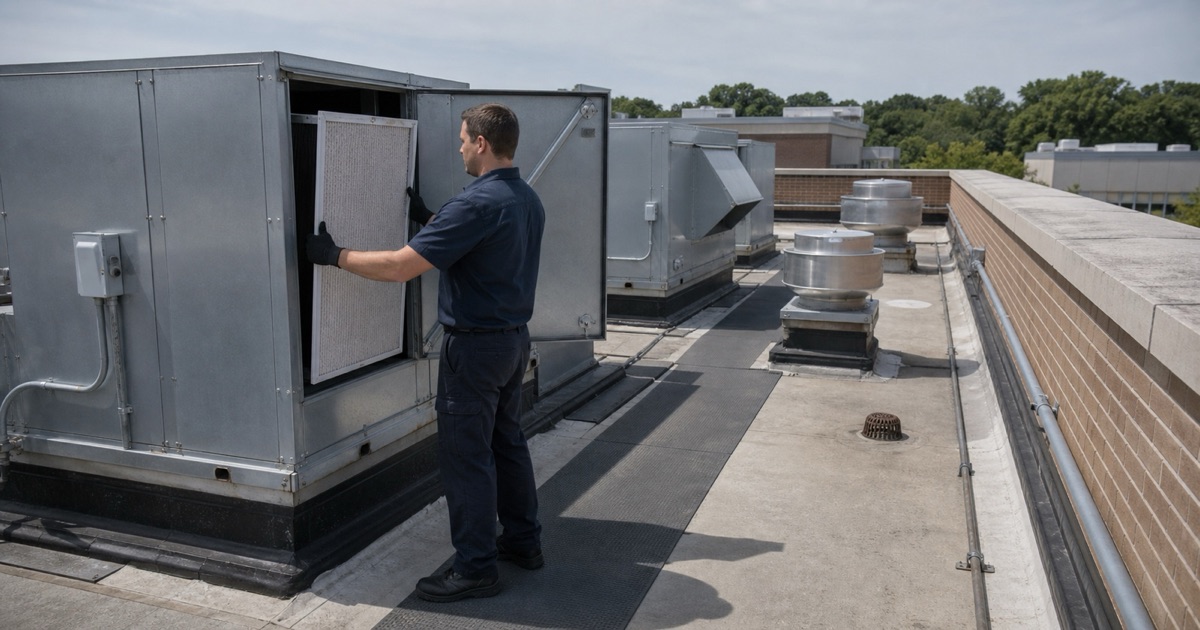
Kitchens That Do Not Close
An acute-care hospital runs patient meal service alongside a staff cafeteria, and neither stops for a contractor’s convenience. There is no overnight window in the sense a restaurant would understand, because the kitchen is producing or preparing at nearly every hour of the day. The work has to fit around that rather than expecting the reverse.
We sequence the work in sections against the meal schedule, isolating and containing one part of a system at a time and returning it to service before the next opens. That takes longer overall than cleaning a system in one pass and it keeps the kitchen operating throughout. On a hospital account that is the outcome that decides whether a contractor is invited back.
Documentation for Accreditation and Review
Hospital facilities departments produce records for accreditation, insurance and regulatory review far more often than commercial operators ever do, and the requests arrive with deadlines attached. What those files need is measured grease depth recorded as a number, photographs filed by area of the system, and a written list of anything that could not be reached with the reason it could not.
A note saying that a kitchen was cleaned answers none of the questions such a department actually gets asked. We keep every report and reissue it on request rather than for the length of a contract, because in an organization of that size the person who commissioned the work is rarely the person who later needs the paperwork.
Two Facilities, Two Sets of Constraints
Two hospitals in one city does not mean two identical accounts. Bed counts, cafeteria hours, contracted food service arrangements and building layouts all differ, and so do the windows available for work. Treating them as one account with one schedule is how a plan fails at the second site.
We plan each facility separately and sequence across both where an operator holds contracts at each. The kitchens are the straightforward part of this work; the scheduling around continuous service is where the difficulty actually sits, and it is where most of the planning effort goes.
Looking for kitchen hood cleaning closer to Laguna Niguel? See Laguna Niguel Kitchen Hood Cleaning.
Corporate Campus and Business Park Dining
Headquarters Cafeterias and Weekday Peaks
Corporate headquarters operations here carry employee dining that peaks Monday to Friday and goes quiet, which is both a different loading pattern from a restaurant and a considerably wider service window. A campus cafeteria closed from Friday evening is one of the easiest things in this trade to plan around properly.
The buyer is facilities management rather than a chef, and what that buyer wants is an interval that holds without chasing, a current compliance file and a vendor record that survives an audit. We produce documentation in that form as standard, because it is what makes an account renew quietly rather than go out to tender every year.
Business Park and Light Industrial Food Service
The city’s business parks carry smaller-scale food service alongside the headquarters operations — cafés, contract catering and occasional production kitchens serving a single building. Those are modest systems, generally with short runs and reachable rooftop equipment, and they are straightforward to service on a predictable cycle.
What they lack is anybody whose job it is to think about them. A café inside an office building frequently has no owner in the maintenance sense, and it drifts until somebody notices. Putting those kitchens on a scheduled interval with a named record is usually the whole value of the account.
Recreational and Club Food Service
Golf and recreational facilities in the city run clubhouse kitchens and event catering that cook against a calendar rather than a daily service. A weekend of events puts more through a hood than the preceding fortnight, and an averaged annual schedule describes neither state accurately.
We schedule against the calendar and band on what the line actually produces during a busy period rather than on a yearly average. Cleaning ahead of a heavy season is worth considerably more than cleaning in the middle of one, and event calendars are generally published far enough in advance to make that straightforward.
Interval, Authority and Records
Banding Institutional Kitchens Honestly
A hospital cafeteria is not a low-volume kitchen simply because it is not a restaurant, and an employee dining room is not high-volume simply because it feeds a lot of people. The fire code bands by what comes off the line — solid fuel monthly, high-volume operations quarterly, moderate volume semi-annually, genuinely low-volume kitchens annually.
We measure and band each kitchen rather than applying an assumption about institutional food service. Some of these kitchens sit further up the table than anybody expects and some sit lower, and only a reading separates the two reliably. Guessing produces a schedule that is wrong in one direction or the other.
A City Fire Department Rather Than the County Authority
Fountain Valley runs its own fire department rather than contracting with the county authority, so plan review, inspection and hood suppression permitting go through the city. It is a small department serving a compact city, and its inspection program covers commercial occupancies directly.
Records are written to be read by that department. Environmental health sits with Orange County Health Care Agency, which posts a pass or closure notification rather than a letter card, so the paperwork addresses two different readers asking two different questions about the same kitchen.
The Record as the Lasting Product
For institutional buyers the document is at least as valuable as the cleaning, because it is what gets produced when somebody asks. Measured depths, photographs organized by area and a written exceptions list are what a facilities office can actually use, and they are what survive being forwarded to somebody who has never seen the building.
We keep those records and reissue them on request indefinitely rather than for a contract term. Accounts change hands, managers move on and contracts get re-tendered, and a record that outlasts all three is worth considerably more than one that leaves with the relationship that produced it.
Access, Scheduling and Practical Constraints
Roof Access on Institutional Buildings
Hospital and corporate campus roofs are not restaurant roofs. Access frequently runs through secured areas, requires escort or sign-in, and sits under the control of a facilities department rather than the kitchen that generated the work. Establishing that route before the night is a scheduling step rather than a formality, and it is the one most often left until too late.
We arrange access in advance and confirm it against the actual building rather than the site as a whole, because a campus with several buildings frequently has several different arrangements. A crew standing at a locked stair at eleven in the evening is a wasted mobilization that somebody pays for.
Working Around Continuous Operations
Neither a hospital kitchen nor a 24-hour cafeteria offers the clean overnight window a restaurant does, so the work is sequenced in sections rather than performed in a single pass. Each section is isolated, contained, cleaned and returned to service before the next one opens, which extends the total time and keeps production running throughout.
That approach also changes what the report looks like, because sections complete at different times rather than together. We record each as it is finished, which is more useful to a facilities team tracking progress than a single completion date covering work that actually happened across several visits.
Coordinating Across Multiple Buildings
A campus or hospital account frequently spans several kitchens in several buildings, each with its own hours, its own management and its own access route. Treating that as one job with one date is how a plan fails at the second building.
We sequence across the whole site so that no two dependent kitchens are offline at once, and we agree the order with the facilities contact rather than proposing it afterwards. On accounts of this size the sequencing is most of the work, and the cleaning is the straightforward part.
- 20+ Years in Orange County
- Overnight & Between Services
- Photographed to Bare Metal










