
Irvine Kitchen Hood Cleaning fits kitchen exhaust system cleaning in Fullerton into a narrow window, because this downtown trades later than almost anywhere else in the county and preps again by morning. Fullerton has the most active late-night dining district in north Orange County, and that single fact shapes how this work has to be scheduled more than anything about the systems themselves.
A downtown that trades until late compresses the working window at both ends. A kitchen closing at one or two in the morning and prepping again by nine leaves a narrow gap, and a crew that needs six hours cannot simply arrive when it suits them. Agreeing the real window before quoting rather than after is the difference between a plan that works and one that collapses in its first week.
Nobody benefits from a schedule that has to be renegotiated after the first visit. It also tells an operator immediately whether a contractor has worked this district before. Most of the difficulty here is logistical rather than technical.
The systems themselves are ordinary; the district around them is not. Anybody can clean a hood; not everybody can do it between two and eight in the morning on a busy street. Scheduling is the constraint that separates contractors here.
The city’s other half is institutional and considerably easier to schedule: two large campuses with dining operations, a hospital, and the food service that comes with both. Those kitchens cook at volume against an academic or clinical calendar, and they offer genuine service windows a restaurant never can. Between them they probably represent more cooking than the downtown does. They are simply less visible, because none of it happens behind a street frontage.
A Downtown That Closes Late
Narrow Windows Between Close and Prep
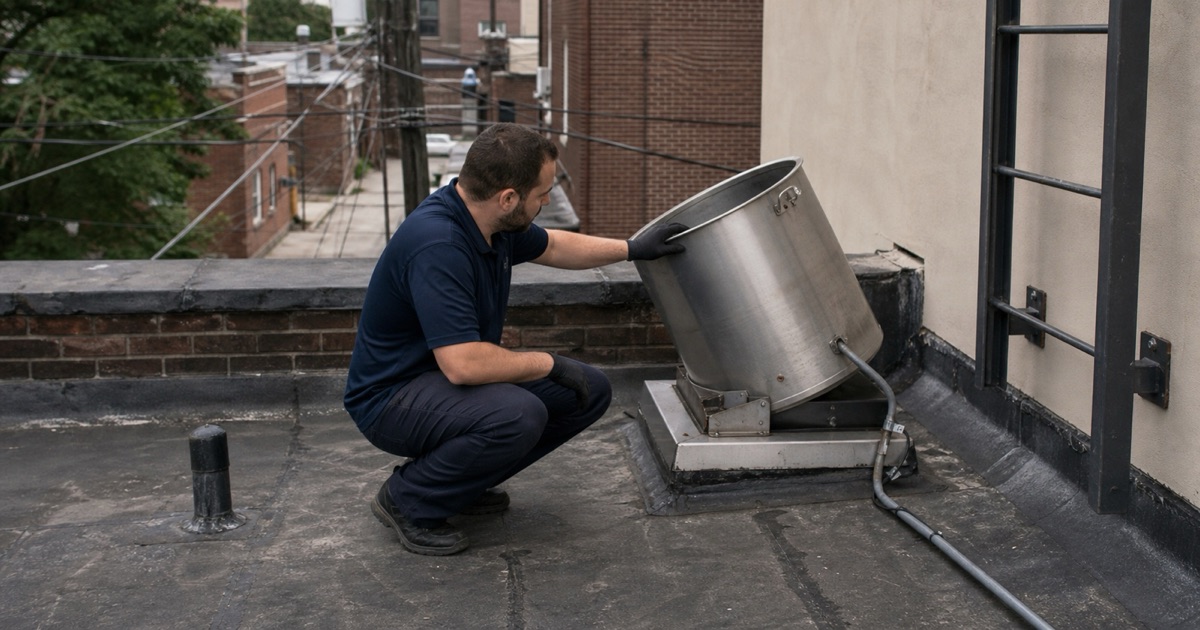
The bar and restaurant district downtown runs later than almost anywhere else in this service area, which leaves a genuinely short gap before morning preparation begins. That is a scheduling constraint rather than an inconvenience, and it decides how much work can be done in a single visit.
We agree the window with each operator before quoting and size the work to fit it, sometimes across two visits rather than one. Splitting a job across two shorter nights is often better than forcing one long one. The system is cleaned properly either way and nobody is rushed at four in the morning. Turning up with a plan built on a normal closing time is how a crew ends up being asked to leave with a system half open.
Alleys Built as Back-of-House
The city documents its downtown alleys as serving the utilitarian needs of the businesses fronting them, which is an unusually explicit acknowledgment that the alley is the working side of the building. For this trade that is good news, because staging, hose runs and roof access all happen there.
It still has to be arranged rather than assumed. Alleys serve several businesses at once and a truck parked across one blocks everybody, so we establish where the vehicle sits and when before the night rather than negotiating it at midnight with a crew waiting. A blocked alley generates complaints from businesses that had nothing to do with the work. Those complaints reach the city rather than the operator who booked us.
Older Buildings and Retrofitted Duct
Downtown Fullerton carries a substantial stock of older commercial buildings, and kitchens fitted into them have duct threaded around structure that was already there. Runs are longer, turn more often, and collect deposits at every change of direction rather than travelling straight to a roof.
Access openings along those runs are frequently too few or too far apart to reach the middle. Those sections appear on our reports with the reason they could not be cleaned, and they usually resolve to listed access panels quoted separately as a one-time fix rather than a recurring exception. In a building of that age, fitting them properly is worth planning rather than improvising.
Looking for kitchen hood cleaning closer to Brea? See Brea Kitchen Hood Cleaning.
Campus and Institutional Dining
University and College Dining Halls
The city carries two large campuses whose dining operations produce at a scale most restaurants never approach, concentrating substantial volume into a small number of hoods. A residential dining hall serving thousands of covers a day loads a system far faster than its footprint suggests. Production of that scale belongs well up the frequency table.
Academic calendars also create genuine service windows, which is rare in this trade. Substantial work — access panel installation, hinge kit replacement, anything that takes longer than a night — belongs in a term break rather than squeezed into an overnight visit during the semester.
Contract Caterers and Who Actually Buys
Campus dining is frequently operated by a contract caterer rather than by the institution itself, which means the buyer, the premises owner and the compliance holder can be three different parties. Establishing who holds the obligation matters before the work rather than after it.
We document to the operator who commissioned the work while keeping the record specific to the premises and the system. That way it survives a change of catering contract, which happens more often than a change of ductwork does. The premises outlast every contract written against them.
Hospital Food Service
The city’s hospital runs patient meal service alongside staff dining with no closing time to work behind, so its kitchen is sequenced in sections rather than taken offline. Each section is isolated, contained, cleaned and returned to service before the next opens.
That takes longer overall and keeps production running throughout, which is the only arrangement a clinical facility can accept. The sequence is agreed with food service management in advance rather than proposed on the night. Their meal schedule is fixed and everything else has to move around it.
Interval and What Sets It
Banding on What Each Kitchen Cooks
The California Fire Code bands cooking volume — monthly for solid fuel, quarterly for high-volume operations including charbroiling, semi-annually for moderate volume and annually for genuinely low-volume kitchens. Floor area and seat count decide none of it.
A late-night grill working every weekend and a campus cafe serving lunch belong nowhere near each other on that table. We measure grease depth and band each kitchen individually rather than applying a district-wide interval for convenience.
Late-Night Trade and Heavier Loading
A downtown kitchen serving until closing time is running its line for considerably more hours than a restaurant that stops at ten, and hours on the line is what accumulates deposits. Two similar kitchens on the same street can sit in different bands purely on trading hours.
That is worth measuring rather than assuming in either direction. An operator who has been on a default schedule set years ago by trading hours that have since changed is very often on the wrong one now. Hours drift gradually and nobody revisits the interval when they do.
Re-Banding When Things Change
Cook lines change, menus change, and a kitchen that adds a charbroiler or extends its hours has changed its band whether or not anybody mentioned it. Nobody thinks to call a hood cleaner about a new appliance, which is fair enough.
We ask at each visit and re-band where the answer has changed. It is also the sensible moment to check that suppression nozzle coverage still matches the appliance line underneath, which is a separate trade’s work and nobody else’s job to notice.
Authority, Records and Wastewater
The City Runs Its Own Fire Department
Fullerton operates its own fire department rather than contracting with the county authority, so plan review, inspection and hood suppression permitting all go through the city. That is a genuine difference from most of the cities immediately around it.
Records are written to be read by that department. Environmental health sits with Orange County Health Care Agency, which posts a pass or closure notification rather than an A, B or C card, so the paperwork addresses two readers asking different questions about one kitchen.
What Each Visit Documents
Every cleaning produces measured grease depth recorded as a number, photographs filed by area of the system, and a written list of anything that could not be reached with the reason it could not be. Those three things answer nearly every question anybody later asks.
We keep the records and reissue them on request indefinitely rather than for a contract term. In a district with regular ownership turnover, a documented history that stays with the premises is worth considerably more than one that leaves with an operator.
Grease and Wastewater Through the City
Fats, oils and grease requirements for food facilities here run through the city’s public works function under the municipal code rather than through a separate district. That is worth knowing because several neighboring jurisdictions are arranged differently.
Wash water and degreaser are captured at source rather than pushed toward a floor drain. Everything sent into a drain line reaches the grease interceptor and brings its next pumping forward, which is an invoice that arrives months later and is rarely connected to the cleaning that caused it.
- 20+ Years in Orange County
- Overnight & Between Services
- Photographed to Bare Metal










