
Irvine Kitchen Hood Cleaning installs grease duct access panels in Irvine, CA and the surrounding cities including Tustin, Santa Ana, Orange, Fullerton and Anaheim. An access panel is a listed opening fitted into a duct run so the interior can actually be reached, and it is the single most common repair that comes out of an honest exhaust cleaning.
The problem it solves is specific. A duct with no openings along its length cannot be cleaned inside, and no amount of returning to the same building changes that. It goes on the exceptions report as a section that could not be reached, and it stays there every visit until somebody fits a panel.
That makes this the repair with the clearest payback on the whole system. It converts a permanent line item on your compliance paperwork into a section that gets cleaned like every other, and it usually costs less than two of the cleanings that were failing to reach it.
Why a Run Ends Up Unreachable
Older Systems Built Before the Expectation
Plenty of duct in this service area was installed when nobody expected anybody to clean inside it, and the run was simply welded up and boxed in. Those systems work perfectly as ductwork and are impossible to service. Finding out which of your runs is in that condition is what an inspection is for, and it is rarely the answer the operator was expecting. It is also not a defect anybody created recently, which usually takes the heat out of the conversation.
Panels That Were Removed or Covered Over
Access panels get built over during a remodel, covered by a dropped ceiling, buried behind a new wall, or removed entirely and patched. From inside the kitchen nothing looks different. The first sign is usually a cleaning report that has quietly stopped mentioning a section it used to cover, which is why comparing reports year over year is worth doing.
Runs Too Long for the Openings They Have
A duct can have panels and still be unreachable in the middle if the openings are too far apart for anybody to work between them. Spacing matters as much as presence. A long horizontal run with a single panel at one end is functionally the same as a run with none, and it is a more misleading situation because the paperwork looks satisfied.
Fitting Panels Properly
Listed Panels, Not Improvised Openings
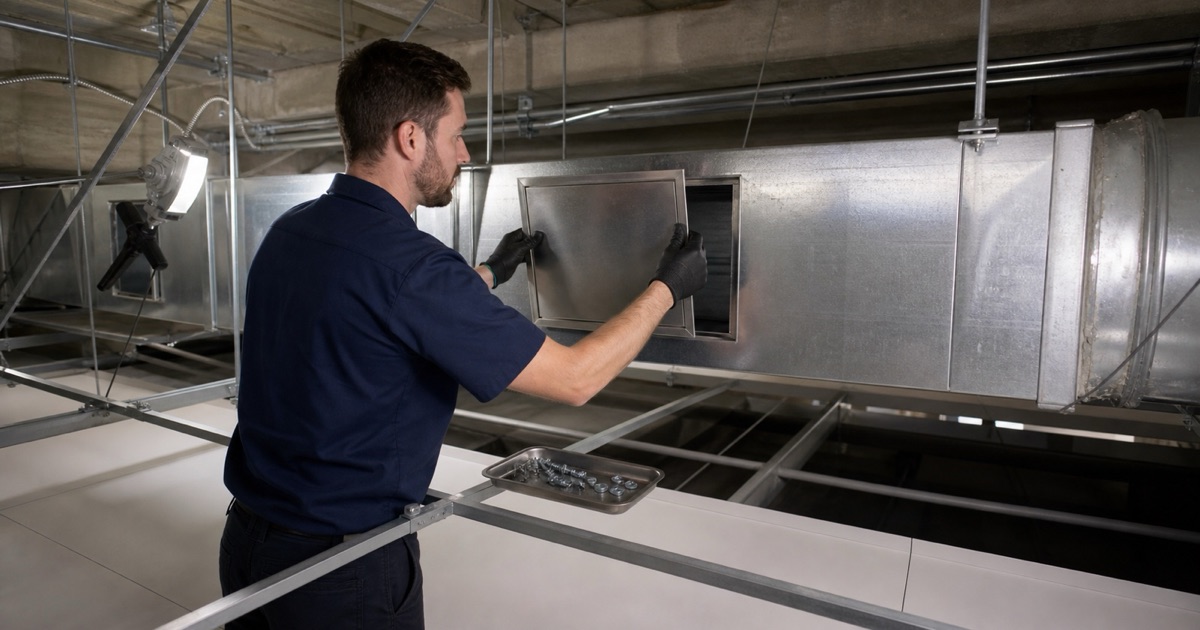
A grease duct opening has to be a listed access panel with a gasket rated for the service, fitted so the duct remains sealed and fire-rated as constructed. Cutting a hole and screwing a plate over it is not the same thing and will be treated as a defect. We fit listed products rather than fabricating an opening on site.
Choosing Where They Go
Panel positions are chosen so the whole run becomes workable rather than so the installation is convenient. That means accounting for the reach of the equipment, the direction of the run, and where changes of direction trap deposits. Getting the placement wrong produces a duct with panels in it that is still not genuinely cleanable, which is the worst of both outcomes.
Sealing, Fire Rating and Enclosures
Where a duct passes through an enclosure or a fire-rated shaft, the panel has to preserve that rating rather than compromise it. This is the part most likely to be done badly by somebody treating the job as sheet metal work. We fit to the assembly the duct is part of, and we say when a run passes through something that needs a different approach.
What Changes Afterward
The Exceptions Report Gets Shorter
The section stops appearing as “could not be cleaned” and starts appearing with a measured grease depth like everything else. That is the whole point. A compliance file with no unresolved exceptions is a materially different document to hand an inspector than one carrying the same unreachable run for six years running.
The Cleaning Gets Genuinely Complete
A system where every run can be reached is a system that can be certified honestly, and it changes what the cleaning is actually worth. Until then you are paying for a partial service and receiving a report that says so, assuming your contractor is writing it accurately. Many do not, which is a separate problem the panel also solves.
It Is Usually a One-Time Cost
Panels do not wear out. Once a run is properly accessible it stays accessible, apart from remodels that build over them again — worth watching if you are refitting a kitchen. Against a recurring exception on every report for the life of the building, a single installation is straightforwardly the cheaper of the two paths, and it is the only one of them that ever actually ends.
- 20+ Years in Orange County
- Overnight & Between Services
- Photographed to Bare Metal