
Irvine Kitchen Hood Cleaning carries out kitchen exhaust inspections in Irvine, CA and the surrounding cities including Tustin, Lake Forest, Santa Ana, Costa Mesa and Anaheim. An inspection is a distinct piece of work from a cleaning, it produces a different document, and on most accounts it is the one the fire code is actually asking for.
This is the part of the trade most often described incorrectly, including by companies selling it. California Fire Code Table 606.3.3.1 is an inspection frequency table. Section 606.3.3.1 sets how often your system must be inspected, and Section 606.3.3.2 requires cleaning when that inspection finds contamination, carried out in accordance with ANSI/IKECA C10. “The code requires quarterly cleaning” is the sentence nearly everyone repeats, and it is not what the code says.
The practical consequence is worth money in both directions. Some kitchens are being cleaned more often than their cooking volume warrants, and some are on a comfortable schedule that their equipment does not support. An inspection settles which, with a measurement rather than an opinion, and leaves you holding a document that an inspector or a carrier will accept.
What an Inspection Actually Establishes
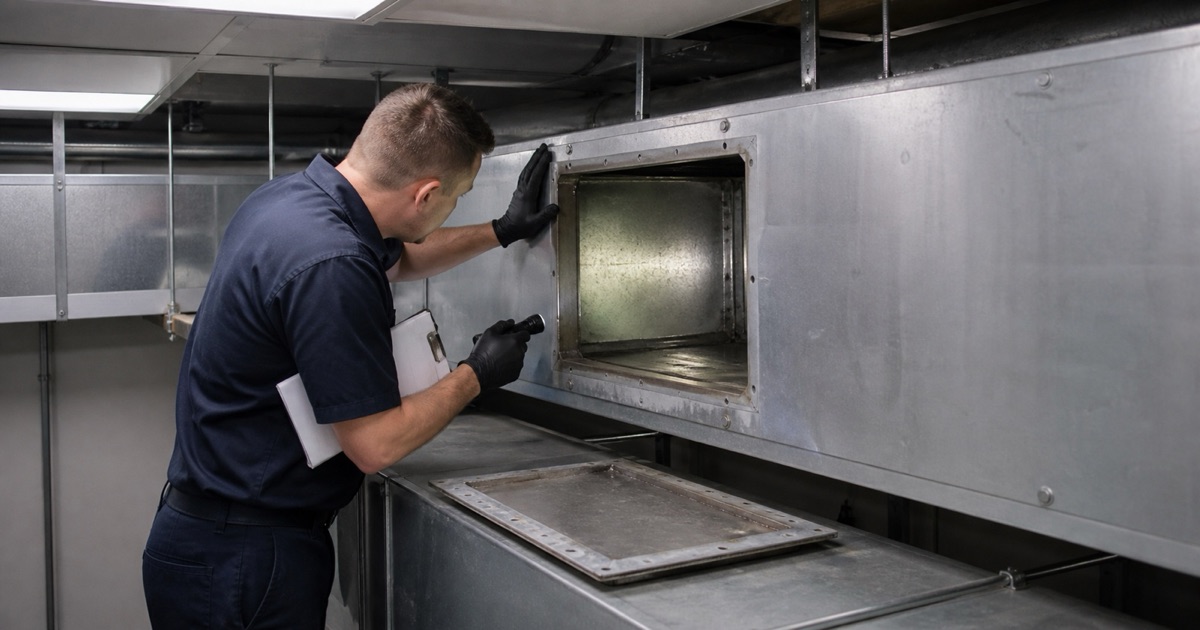
Measured Grease Depth, Not an Opinion
Depth is measured with a comb at defined points through the system and written down as a number. NFPA 96 treats roughly 2,000 micrometers — about 0.078 inch — as the point at which a system requires cleaning. Recording the reading turns “it looked dirty” into something a later reader can act on, compare against the previous visit and defend to somebody who was not standing in the kitchen at the time.
Which Sections Are Reachable at All
An inspection establishes where the access points are, which runs can be opened, and which cannot be reached with the panels currently fitted. That map is the single most useful thing an older system can be given, because it converts a vague sense that “the duct gets done” into a list of sections that genuinely do and genuinely do not. Everything downstream — quoting, scheduling, certification — depends on it being accurate, and an inspection is the only point in the cycle where anybody is being paid to establish it rather than assume it.
Equipment, Listings and Condition
We record what the hood is listed as, what the filters are, whether the fan can be lifted, and the condition of the components that decide whether a future cleaning can be done properly at all. A seized hinge kit, a missing grease cup or a filter bank that no longer seats are all inspection findings before they are repair quotes. Establishing them on paper is how they stop being discovered again every year by a different crew who each report the same finding and none of whom are asked to fix it.
Setting the Right Interval
Banding by What You Actually Cook
The bands are monthly for solid fuel cooking, quarterly for high-volume operations, semi-annually for moderate volume, and annually for low-volume kitchens such as churches, seasonal operations and senior centers. Orange County Fire Authority Guideline D-02 names 24-hour cooking, charbroiling and wok cooking in its high-volume band. We band the account on the equipment that runs rather than the description on the lease.
Where the Default Six Months Is Wrong
A flat semi-annual schedule applied to every account is a scheduling convenience rather than a code position, and it is wrong in both directions. A wood-fired oven or a daily wok line sits well inside it and will load between visits. A low-volume senior dining room or a seasonal operation sits well outside it and is paying for cleanings its cooking has not earned. Neither situation is discovered without measurement, and neither is corrected by a service company whose schedule was set once at the start of the contract and never revisited.
Re-Banding When the Kitchen Changes
Cook lines change, menus change, and a kitchen that swaps a flat top for a charbroiler has changed its band whether or not anybody told the service company. An inspection catches that. It is also the right moment to check that suppression nozzle coverage still matches the appliance line underneath, which is a separate trade’s work but nobody else’s job to notice.
The Documentation You Are Left Holding
The Service Tag and What Goes On It
The California Fire Code requires a tag recording who inspected or cleaned the system, when, and what was not cleaned, and it requires prior tags to be covered or removed so the current one is unambiguous. Title 19 of the California Code of Regulations separately makes removing or defacing a required tag an offense. That is why tags are handled by us rather than by kitchen staff tidying a wall.
A Report Written for Somebody Who Was Not There
The report carries the measured depths, the photographs filed by area, the accessible-section map and the exceptions list, in a structure that survives being forwarded. The people who read it are usually a fire inspector, an environmental health inspector, an insurance carrier or a new owner’s attorney, and none of them were in the building. Writing for that reader is a deliberate choice rather than a formatting preference.
Records, Retention and Producing Them on Demand
We keep every inspection and cleaning record and reissue it on request for as long as you are an account. The request nearly always arrives after something has happened — a claim, a correction notice, a sale — at exactly the point where reconstructing the history from memory is impossible. Records are worth precisely as much as your ability to produce them on the day.
Inspections Driven by Something Going Wrong
After a Correction Notice
A correction notice names a deficiency and a date, and clearing it usually means a documented inspection, whatever cleaning the findings require, and a re-inspection. Re-inspections are billable time in most jurisdictions, so the second visit costs more than the first. We schedule against the notice date rather than the next convenient slot, and we write the paperwork to close the item rather than to describe it.
For an Insurance Carrier or a Renewal
Carriers writing restaurant programs increasingly want documented cleaning on a stated interval, and some policies carry an endorsement that conditions coverage on it. The document a carrier wants is not the same as a receipt. An inspection report with measured depths and dated photographs is the version that survives an adjuster’s review after a fire, which is the only moment it will ever genuinely matter.
Before Buying or Taking On a Lease
Taking over a restaurant means inheriting its exhaust system, its access problems and whatever the previous operator deferred. An inspection before signing establishes what condition the system is actually in and what it will cost to bring to a cleanable state. It is a small cost against a lease, and it is the one piece of due diligence on a kitchen that nobody thinks to do until afterward.
- 20+ Years in Orange County
- Overnight & Between Services
- Photographed to Bare Metal