
Irvine Kitchen Hood Cleaning can service most of the kitchen hood cleaning in Ladera Ranch from one setup, because essentially the whole commercial base of this community stands at a single intersection. Ladera Ranch is a master-planned community rather than an incorporated city, and both halves of that description matter to how this work is arranged.
The commercial base is unusually concentrated. Essentially all of it sits in a group of adjoining centers clustered at or beside one intersection, rather than being distributed along arterials or gathered into a downtown. For a service that arrives by truck with containment equipment, having every kitchen in a community within a few minutes of each other is a genuine planning advantage.
Being unincorporated is the other half. There is no city hall here, so the fire authority, the health authority and the permit counter are all county or district bodies. That is straightforward once known and a source of confusion for contractors who work mainly in cities and reach for a municipal department by habit.
An Entire Commercial Base at One Intersection
Concentration as a Planning Advantage
When every commercial kitchen in a community sits within a short walk of every other, a night’s work can cover several accounts without the setup and relocation time that dominates a distributed route. Containment goes up and comes down fewer times, and the truck moves rarely. That efficiency is real and it belongs in the price rather than in our margin. An operator who is easy to serve should see that reflected in what they pay.
We plan the community as a route rather than as unrelated appointments for that reason. Where several operators in the same cluster are on similar intervals, sequencing them into one night is straightforward and costs each of them less than a separate mobilization would.
Multi-Tenant Centers and Shared Roof Planes
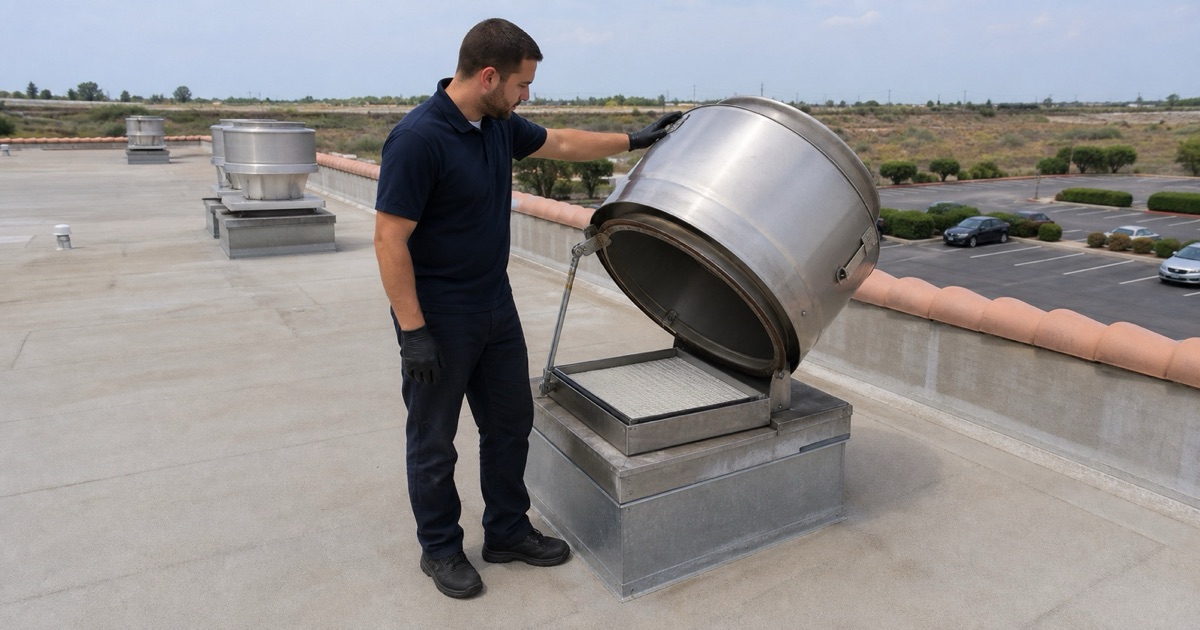
These are large multi-tenant centers with continuous roof planes and rooftop equipment for many units sitting close together. Access is generally direct, and identifying which fan serves which tenant is a real step rather than an assumption. A fan a few feet from one back door frequently belongs to the unit next along.
We identify equipment against the unit and check containment under each fan separately, because a serviced containment box under one tenant’s discharge does nothing for the fan beside it. Both are checked on every visit rather than carried forward from a previous report.
Center Management as the Practical Gatekeeper
In centers of this size the roof, the staging areas and the permitted working hours are controlled by center management rather than by any individual tenant. Access is granted rather than assumed, and it is granted on the understanding that it will not become a problem for the property.
We agree access and timing with management once and work to it, which means individual tenants do not have to negotiate it each time. That arrangement is also what makes coordinated servicing across several units in one night possible at all. Without it every tenant negotiates separately and the roof gets opened repeatedly.
Looking for restaurant hood cleaning closer to Anaheim? See Restaurant Hood Cleaning Services in Anaheim.
Serving an Unincorporated Community
County Authorities Rather Than a City
For a kitchen here the fire authority is Orange County Fire Authority, which serves all unincorporated areas of the county alongside its member cities. Environmental health sits with Orange County Health Care Agency, and building and mechanical permits go to the county rather than to a municipal counter.
None of that changes the obligations themselves — the fire code and the retail food code apply exactly as they do anywhere else — but it changes who reads the paperwork and where an application goes. We write records to the authority that will actually read them, which is a small courtesy that reads as competence. It also avoids a follow-up question at exactly the moment nobody wants one.
Guideline D-02 Without a Municipal Layer
Because the authority here is the county rather than a city with its own amendments, the frequency banding comes from OCFA Guideline D-02 without a municipal layer on top. Solid fuel sits in the monthly band, high-volume operations including charbroiling and wok cooking in the quarterly band, moderate volume semi-annually and genuinely low-volume kitchens annually.
That makes the compliance picture simpler here than in several neighboring cities that run their own departments and their own submittal requirements. One authority, one guideline and one banding table across the whole community. That consistency is worth more than it sounds when an account spans several tenants.
Where This Community Ends and the Next Begins
Ladera Ranch sits beside other master-planned communities, and published figures about retail floor space in this area frequently cover more than one of them together. That is worth knowing because it affects what anybody assumes about the size of the market here.
For our purposes the boundary matters practically rather than descriptively: a center a short distance away may sit in a different community with a different set of local arrangements. We work from the address rather than from a district name, because names in this part of the county are used loosely and boundaries are not. An address resolves the question in one step and never needs revisiting.
Interval, Records and Practical Handling
Banding on What Comes Off the Line
The bands follow cooking volume rather than floor area or seat count, which is the assumption we most often correct. Two restaurants of similar size in the same center can sit in different bands if one runs a charbroiler through every service and the other does not.
We measure grease depth rather than estimating it, and we band each kitchen on the equipment that actually runs. Applying one interval across a whole center is a scheduling convenience rather than a code position, and in a mixed center it is wrong for most of the tenants in it.
What Each Visit Documents
Every cleaning produces measured grease depth recorded as a number, photographs filed by area of the system, and a written list of anything that could not be reached with the reason. Those three things answer nearly every question anybody subsequently asks about a kitchen.
For a tenant inside a managed center the documentation does a second job as well. It separates that unit’s system from the building’s, which is the difference between answering an inspector directly and having to go and ask center management for paperwork that mentions somebody else’s kitchen.
Grease, Wastewater and Capture
Fats, oils and grease requirements here run through the local water district rather than a city department, and that district serves a wide area of south county. Wash water and degreaser are captured at source rather than sent toward a floor drain.
Capturing it is both the correct handling and cheaper for the operator, because everything a cleaning sends into a drain line ends up in the grease interceptor and brings its next pumping forward. That cost appears months later on a separate invoice, and almost nobody connects the two without being told. We would rather say it up front than have an operator pay twice quietly.
The saving is small per visit and meaningful across a year. Over a full interval cycle it usually exceeds the difference between two quotes.
Cooking, Access and What Actually Varies
A Retail Mix Rather Than a Restaurant District
The commercial base here is retail-anchored, with grocery, service and casual dining rather than a concentration of full-service restaurants. That mix produces a range of cooking rather than a single profile, from grocery prepared-foods departments through casual chains to a small number of kitchens running heavier equipment.
A grocery prepared-foods operation is a genuine commercial kitchen with a Type I hood and a real obligation, and it is the one most often overlooked because it sits inside a store rather than behind a restaurant frontage. We treat it as what it is rather than as an afterthought attached to a retail account.
Access, Staging and Working Hours
Centers of this size control their own roof access, staging areas and permitted contractor hours, and those arrangements are agreed with management rather than assumed by a contractor. Working within them is straightforward once established and a source of friction when it is not.
We agree access once and work to it on every subsequent visit, which means individual tenants are not renegotiating it each time. It is also what makes it possible to service several units in one night rather than returning repeatedly to the same roof.
Community Expectations About Noise and Timing
A master-planned community with housing close to its commercial center has expectations about late-night activity that a purely commercial district does not. Equipment noise at two in the morning carries further than anybody expects, and a complaint makes every subsequent visit harder to arrange.
We plan the approach and keep the setup tight, and where an early morning works as well as an overnight we would rather take it. Protecting the ability to work here at all is worth more than the convenience of any single visit.
- 20+ Years in Orange County
- Overnight & Between Services
- Photographed to Bare Metal










