
Irvine Kitchen Hood Cleaning finds kitchen hood cleaning in Laguna Niguel unusually straightforward, because the city’s kitchens sit in single-story open-air centers with direct roof access and room to stage a truck. Laguna Niguel is one of the more straightforward markets in this service area to work in, and that is worth stating plainly rather than dressing up, because the practical conditions here remove most of the difficulties that complicate the job elsewhere.
The city’s commercial cooking sits in single-story open-air centers spread across four or five arterial nodes rather than concentrated in a downtown or enclosed in a mall. Roof access is generally direct, staging space is available, and the equipment serving a given unit is usually close to it and easy to identify. None of that is true in a historic district or an enclosed center. Working here is genuinely easier, and the price should reflect that rather than quietly absorbing it.
What that means for an operator is a cleaner quote and a shorter night. It also means there is very little excuse for a system here to be carrying sections that have never been opened, because the access difficulties that explain that elsewhere mostly do not apply.
Open-Air Centers and Direct Access
Single-Story Buildings and Reachable Equipment
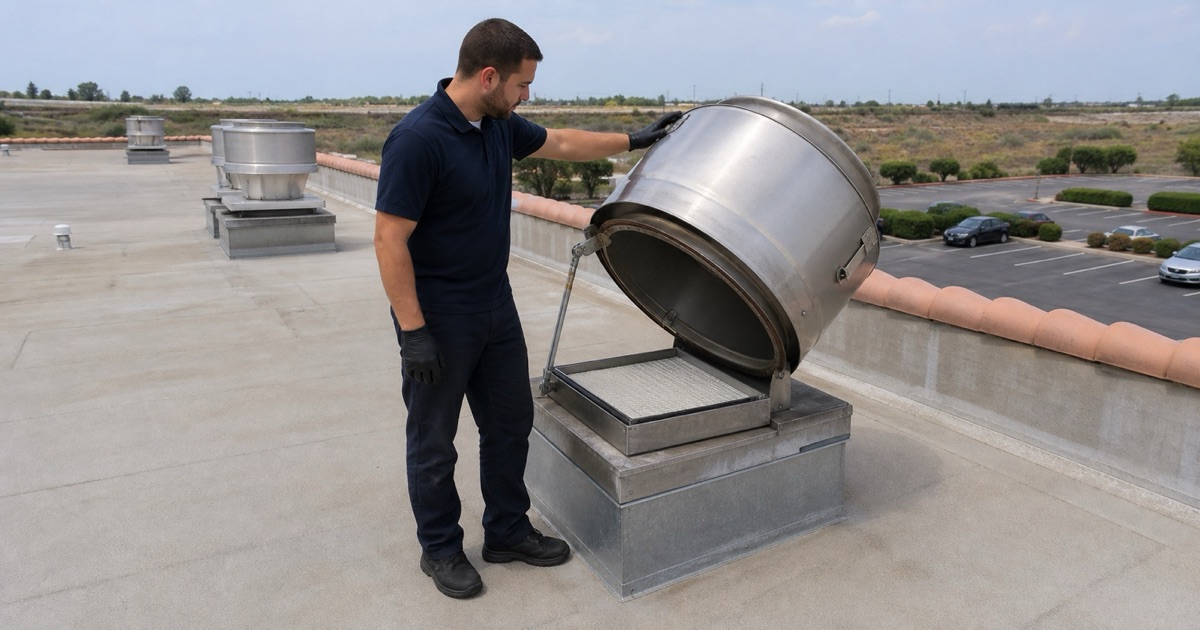
A single-story open-air center puts the rooftop fan a short distance above the kitchen it serves, with a straightforward route up and room to work once there. The duct run between them is usually short and simple, which reduces both the time on site and the number of places deposits can accumulate unseen. That is the easiest configuration this trade encounters.
It also makes the work verifiable in a way that a long concealed run is not. Where a system is short and reachable end to end, a report claiming the whole thing was cleaned can be checked, and there is no section anybody can reasonably claim was inaccessible. We photograph each part accordingly. Where a whole system is visible, the photographs are a record rather than a sample.
Staging and Surface Parking
These centers carry generous surface parking, which means a truck can be positioned near the work rather than several hundred feet away with hose running across a public walkway. Setup is faster, containment is simpler and the disruption to neighboring tenants is minimal. Those are unglamorous advantages and they show up directly in what a visit costs.
We still agree access and timing with center management rather than assuming it, because a multi-tenant center has its own rules about when contractors may work and where vehicles may sit. Agreeing that once means it does not have to be renegotiated on every subsequent visit. Centers appreciate a contractor who asks once and then works within the answer.
Identifying Equipment on a Shared Roof Plane
Even on an easy roof, several tenants’ fans sit close together on a continuous plane, and working out which belongs to which unit is a real step rather than an assumption. A fan close to one tenant’s back door frequently serves the unit beside it, and the containment under one does nothing for its neighbor.
We identify equipment against the unit rather than inferring from position. Getting it wrong means cleaning somebody else’s system and invoicing the wrong operator, which is an easy mistake on a roof where everything is reachable and nothing is labeled. We label what we service so the next visit does not repeat the exercise.
Looking for kitchen hood cleaning closer to Ladera Ranch? See Kitchen Hood Cleaning in Ladera Ranch.
A Center That Sits Across a City Line
Where the Jurisdiction Changes Mid-Center
One of the city’s larger retail centers sits at the boundary with the neighboring city, and centers in that position raise a question worth settling early: which authority covers a given unit, and which agency handles its wastewater and grease requirements. The answer can change across a parking lot.
We establish that from the address rather than from the center’s name or its signage. It matters because records written to the wrong authority read as unfamiliar with the area, and because fats, oils and grease obligations genuinely differ between neighboring jurisdictions in this part of the county.
Addresses That Do Not Match Expectations
A center straddling a boundary frequently carries tenants whose postal address suggests one city while the property sits in another, and published restaurant listings reflect that inconsistently. That is an administrative curiosity for most people and a practical question for anybody filing compliance paperwork.
We check the address against the jurisdiction rather than trusting a listing. It takes a moment at the first visit and then never needs repeating, and it avoids the situation where a perfectly good service record names a department with no authority over the property.
Consistency Across a Multi-Site Operator
Operators with units on both sides of a boundary end up with two sets of authorities for what feels like one account. Keeping that straight is part of the service rather than the client’s problem to manage.
We document each site to its own jurisdiction while keeping the format identical across the account, so the records remain comparable even though the authorities differ. That combination is what lets an operator compare their own sites without having to translate between two sets of paperwork. Comparability across sites is most of the value once an account has more than one. A single site only ever has itself to be compared against, and that takes years to become useful.
Cooking, Interval and Local Authorities
Banding on What Each Kitchen Cooks
The fire code bands cooking volume — monthly for solid fuel, quarterly for high-volume operations including charbroiling, semi-annually for moderate volume and annually for genuinely low-volume kitchens. Floor area and seat count decide none of it, which is the assumption we most often have to correct.
The restaurant mix here runs heavily to neighborhood casual formats rather than high-heat specialist cooking, and a good many of these kitchens genuinely sit in the moderate band. That is a finding rather than a discount, and it comes from a measurement rather than from a general impression of the city.
Orange County Fire Authority
Laguna Niguel is an OCFA member city, so plan review, inspection and the Guideline D-02 frequency banding all run through that authority. That gives the city one consistent set of expectations, which is useful for an operator running more than one unit here.
Environmental health sits with Orange County Health Care Agency, which posts a pass or closure notification rather than an A, B or C card. Any material promising to protect a letter grade in this city was written for somewhere else and describes something that does not happen here.
Grease, Wastewater and Capture at Source
Fats, oils and grease requirements run through the local water district rather than the city, and wash water and degreaser are captured rather than pushed toward a floor drain. That is the correct handling, and it also keeps a cleaning from filling an interceptor at the operator’s expense.
The second cost is invisible on the night and obvious two months later, when an interceptor needs pumping sooner than budgeted and nobody connects the two events. Capturing at source removes that entirely, which is worth more to most operators than a marginally cheaper visit.
What Each Visit Leaves Behind
Photographs Filed by Section
Every cleaning ends with photographs of bare metal taken at the surface, organized by area so the hood, the plenum, the duct and the rooftop fan each carry their own evidence rather than sharing one image. Where a system is short and genuinely reachable, that documentation can be checked against the system itself, which is not true of a long concealed run.
That verifiability is the quiet advantage of working in a city built this way. An operator can look at the photographs and at their own equipment and satisfy themselves that the two match, which is a position very few restaurant operators are ever actually in.
Depth Measured Rather Than Estimated
Grease depth is taken with a comb at defined points and recorded as a number, against roughly 2,000 micrometers as the threshold NFPA 96 treats as requiring cleaning and about 50 micrometers as the standard a completed cleaning reaches. Adjectives are not useful to anybody reading the record later.
Those readings are what settle an argument about interval in either direction. A kitchen convinced it needs quarterly attention and one convinced it needs almost none are both answered by the same measurement, taken twice and compared.
Exceptions, and Why There Should Be Few Here
Anything not reached is named with the reason, and in a city of short accessible runs that list ought to be very short indeed. Where it is not, the reason is usually a missing access panel on a slightly longer run rather than anything structural.
Each item converts into priced work rather than a recurring note. Closing one costs a fraction of what it costs to keep reporting the same unreachable section on every visit for the life of the tenancy, and the arithmetic is rarely difficult once somebody puts a number on it.
- 20+ Years in Orange County
- Overnight & Between Services
- Photographed to Bare Metal










