
Irvine Kitchen Hood Cleaning approaches kitchen hood cleaning in Lake Forest as a routing problem first, because the city’s kitchens sit in three separately annexed pockets rather than one commercial core. Lake Forest is not laid out like a city with a downtown, and that shapes how this work is planned more than anything about the kitchens themselves.
The commercial cooking here sits in physically separate pockets rather than one core. Foothill Ranch and Portola Hills were annexed in 2000 and Baker Ranch is newer still, so the city is a set of distinct developments that grew separately and were stitched together administratively. The result reads as one city on a map and behaves as three on a service route.
For a service that arrives by truck with equipment and a containment setup, that geography is the whole planning problem. Three pockets is three stops, and treating them as one address is how a schedule slips. The distances are short and the setup time is not, which is where the night actually goes.
A City Made of Separate Pockets
Foothill Ranch, Portola Hills and Baker Ranch
Foothill Ranch carries the largest concentration of national casual and quick-service kitchens in the city, built around a town center format with big-box anchors. Portola Hills and Baker Ranch are separate again, each with their own smaller commercial provision. Each grew to serve the housing around it rather than the city as a whole.
None of these is far from the others in absolute terms, but they do not share a service street or a common back-of-house. A crew working the city in one night is genuinely relocating between them rather than moving down a block. Containment comes down and goes back up at every stop, and that is the cost nobody quotes for.
Route Planning as Part of the Quote
Because of that, we plan the route before quoting rather than pricing each kitchen as though it stood alone. Multiple kitchens in one pocket on one night is efficient; the same number scattered across three is not, and pretending otherwise produces a schedule that fails in week two. A route that looks efficient on a map and ignores setup time is a route that runs late every cycle.
Where an operator has several sites across the city, sequencing them sensibly across a night or two is worth more than a marginal difference in the per-kitchen price. That is a conversation we would rather have up front. It usually saves more than any line-item negotiation on the quote itself would.
Pad Restaurants and Their Rooftop Equipment
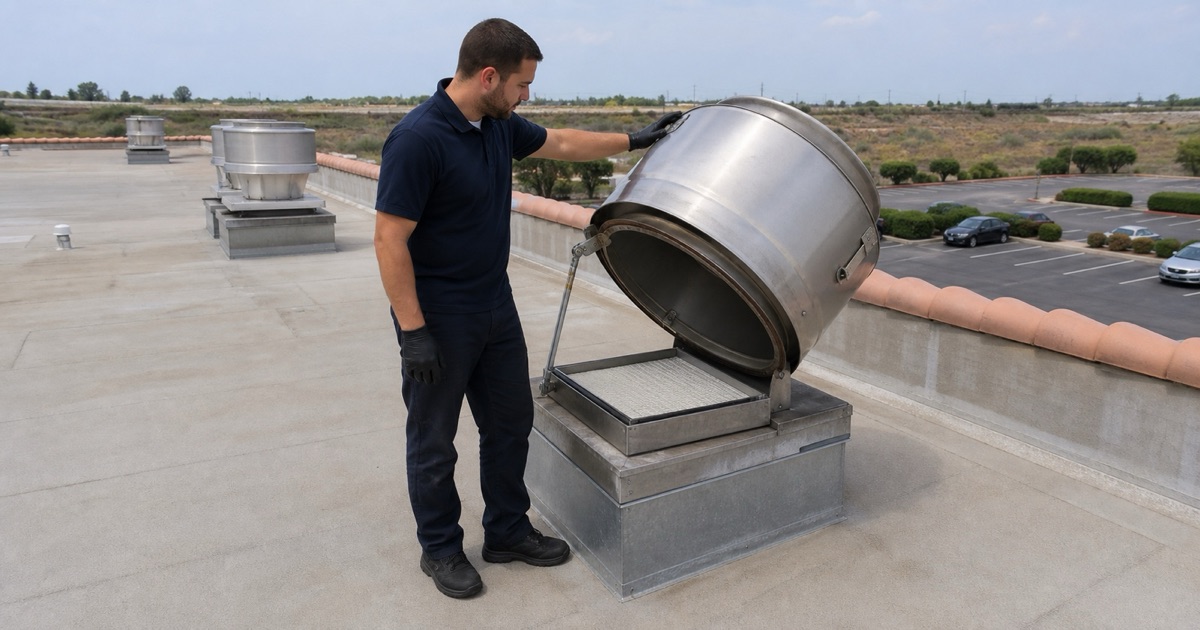
Much of the city’s restaurant stock sits in freestanding or end-cap pads with their own roof and their own upblast fan, rather than in a shared multi-tenant envelope. That is generally good news for access. Nobody has to be coordinated with, and the roof belongs to the kitchen underneath it.
A pad building usually means a short run, a reachable fan and straightforward staging. It also means the fan is entirely that tenant’s problem, including the grease containment beneath it and whatever it has been depositing on the membrane. On a pad building there is no landlord to share that question with, which simplifies it considerably.
Looking for kitchen hood cleaning closer to North Tustin? See Kitchen Hood Cleaning in North Tustin.
Big-Box, National Brands and Volume Kitchens
National Casual and Quick-Service Formats
Chain kitchens run to a specification, which makes them predictable to service and easy to band correctly. Fryer-heavy quick-service formats load a system faster than their floor area suggests, because fryer vapor is fine and carries a long way down a duct. It condenses well past the hood, in the section nobody thinks of as the greasy part.
Those brands also tend to hold their own maintenance standards and want documentation in a particular form. We supply measured grease depth and photographs by area rather than a signed sheet, because that is what survives a brand audit. A signed sheet proves attendance; a measurement proves the work.
Large-Campus and Assembly Food Service
Lake Forest carries food service at a scale beyond its restaurant stock, including a large church campus and a continuing-care community. Kitchens serving assembly and event catering cook in bursts rather than continuously. A weekend can put more through a hood than the preceding fortnight did.
A kitchen that does four large services in a fortnight and nothing in between is misrepresented by an averaged schedule in both directions. We band on what actually comes off the line, and where an operation is event-driven we schedule against its calendar. Cleaning the week before a heavy season is worth more than cleaning on a fixed date in the middle of one.
Continuing-Care and Senior Dining
A continuing-care community here operates dining for residents who rely on it daily, which puts the same constraint on this work that it does anywhere else: the kitchen cannot simply be taken offline for a night. Residents eat on a schedule that does not move to suit a contractor.
The work gets staged so service continues, and the interval gets set by the cooking rather than by an assumption about the setting. Senior dining is often lighter cooking, but “often” is not a basis for a schedule and a measurement is. Some of these kitchens produce three full services a day, which is not light by any reading.
Utilities, Authorities and the Practical Details
Four Water Districts in One City
Lake Forest is split between several water districts, and which one covers a given address decides where a food facility’s grease interceptor and fats, oils and grease requirements come from. Four separate districts serve parts of the city. Which one applies is decided by the address rather than by anything visible from the street.
That is worth knowing before anybody assumes the rules are uniform across town. Two restaurants a few minutes apart here can answer to different agencies on the wastewater side, and a contractor who has not noticed will eventually give somebody the wrong answer. The wrong answer here is the kind that surfaces during an inspection rather than before one.
Orange County Fire Authority
Lake Forest is an OCFA member city, so plan review, inspection and the frequency banding in Guideline D-02 all run through that authority. That makes the fire side more consistent than the water side. One authority, one guideline and one banding table across the whole city.
Records are written to be read by OCFA, and we keep them and reissue them on request. The request usually arrives long after the visit, from an inspector or an insurer, at exactly the point where memory has stopped being useful. We keep them indefinitely for that reason rather than for the length of a contract term.
Interval Set by Cooking, Not by Address
Across every pocket of this city the same principle applies. The fire code bands cooking volume — monthly for solid fuel, quarterly for high-volume operations including charbroiling, semi-annually for moderate volume, annually for genuinely low-volume kitchens.
A national casual restaurant with a charbroiler and a senior dining room in the same city belong in different bands, and both are wrong if they are put on a default six-month cycle. One is being under-served and the other is being over-billed, from the same assumption. We measure, band and say plainly where each kitchen lands.
What the Report Has to Show
One Standard Across Every Pocket
Whether a kitchen sits in a town center, on a freestanding pad or inside a campus building, the record it receives is identical in structure: measured depths, photographs by area, and a written list of anything that could not be reached.
For an operator with sites in more than one part of the city, that consistency is the point. It allows two kitchens to be compared directly rather than through two contractors’ different ideas of what a service report should contain. Comparability is most of the value of a record once you have more than one site.
Depth as a Number
Grease depth is measured with a comb rather than characterized in words, against roughly 2,000 micrometers as the threshold NFPA 96 treats as requiring cleaning and about 50 micrometers as the standard the work reaches.
That number is what makes a cleaning history informative. Three visits of measurements tell you whether an interval is right; three visits of “system cleaned” tell you only that somebody attended. The second kind of record is common and almost worthless.
Exceptions and the Repairs They Imply
Anything not reached is named with its reason, and on pad buildings that is usually a short list while on older or retrofitted runs it can be longer. Either way the list is the honest half of the report. It is also the half that decides what next year’s visit will actually be able to reach.
Most items on it resolve to a listed access panel or a hinge kit, quoted separately. Those are one-time costs that stop the same exception reappearing on every subsequent report for the life of the building. Weighed against a recurring exception, they are rarely a difficult decision once they are priced.
- 20+ Years in Orange County
- Overnight & Between Services
- Photographed to Bare Metal










