
Irvine Kitchen Hood Cleaning concentrates kitchen hood cleaning in Mission Viejo on two buildings rather than a district: an enclosed mall food court and a hospital whose cafeteria runs around the clock. The demand here concentrates in an enclosed regional mall and a large hospital rather than spreading along a street, which makes the market unusually easy to describe and unusually particular to work in.
A food court is a specific technical situation. Many small tenants cook in a compact area, frequently with exhaust arrangements that were designed for the court as a whole rather than for any individual unit. What one tenant does affects what the others experience.
Shared infrastructure means a neglected unit is not only its own operator’s problem. A court’s exhaust performance is the sum of what every tenant in it does, and one unit running unserviced affects the capture the others get. Center management usually understands that faster than the tenants do. They are the ones who hear about it when a court starts smelling of grease.
Complaints reach management long before they reach the unit responsible. By then the question is about the whole court rather than one kitchen. Coordinated servicing avoids the situation arising in the first place.
The hospital at the other end of the city presents the opposite problem: a single large kitchen that never closes, serving people who cannot go without a meal while a system is offline.
Food Court Kitchens and Shared Exhaust
Small Tenants, Compact Cooking, Shared Infrastructure
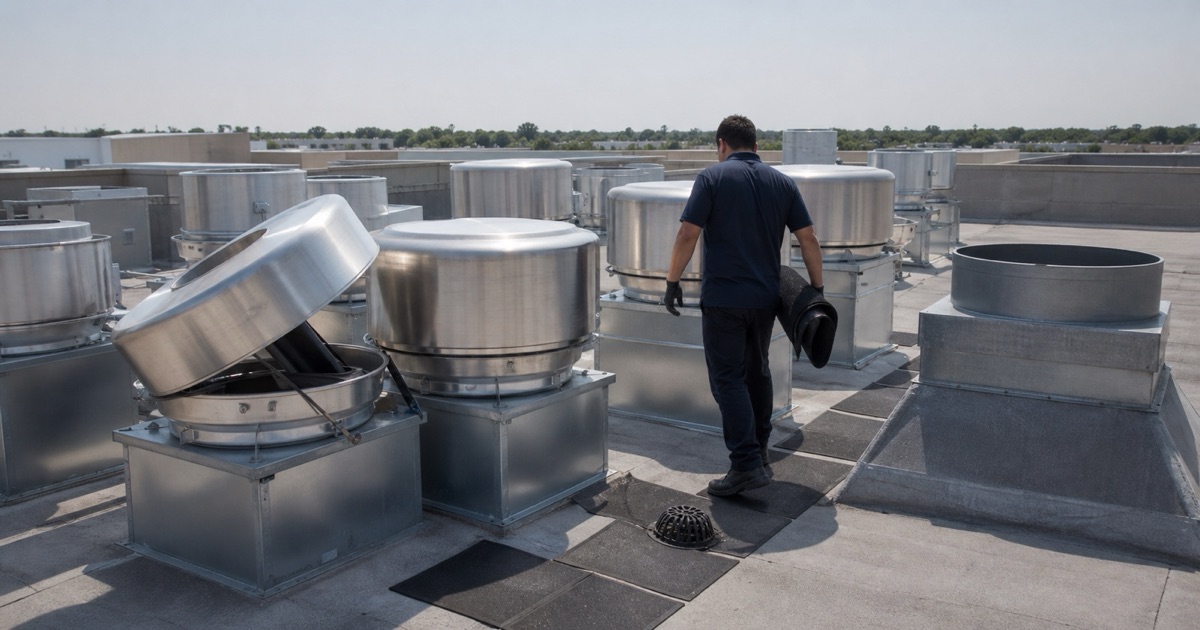
An enclosed mall food court puts a dozen or more kitchens into a small footprint, each with its own hood but often with exhaust infrastructure that was planned for the court collectively. Individual tenants frequently have no idea where their duct goes after it leaves the ceiling.
We establish the route before quoting rather than after, because run length and access decide both price and time. On shared infrastructure it is also the only honest way to say which sections belong to which tenant and which are genuinely common. Common sections need an owner named before anybody can be billed for them. Center management is usually the only party with standing to settle that, and it is a far easier conversation held before a cleaning than after an invoice.
That conversation is easier before a cleaning than after one. Afterwards it becomes an argument about an invoice rather than a question about a duct. A hospital cafeteria running continuously has no comparable window anywhere in its week.
Turnover and Inherited Systems
Food court units turn over faster than almost any other restaurant format, and each incoming tenant inherits whatever the previous one left above the ceiling. A unit can change hands twice without anybody opening the duct.
An inspection at handover establishes what condition the system is in and what it will cost to bring to a cleanable state. It is a small cost against a lease and it is the piece of due diligence that nobody performs until it is too late to negotiate over. By then the condition of the duct is the new tenant’s problem regardless of who created it.
An inspection before signing costs a fraction of the remedy. It also gives a new tenant something to negotiate with while there is still leverage. Establishing the route once removes the guesswork from every subsequent visit.
Coordinating a Court Rather Than a Unit
Servicing a food court unit by unit as each tenant happens to call produces repeated disruption, repeated roof access and no consistency. Coordinated visits arranged with center management work better for everyone including the tenants.
We still document tenant by tenant, because an individual operator has to be able to answer an inspector about their own kitchen. Coordination is about how the work happens; the record has to stay specific to the unit that paid for it. Those two things are frequently confused and they are not the same.
Back-of-house access in an enclosed mall is controlled by center management rather than by any tenant, and delivery timing, dock availability and permitted contractor hours all have to be agreed before a visit is booked. Equipment and containment come in through the same service corridors the tenants take deliveries through, so the timing of the work has to sit outside delivery windows rather than across them.
Looking for kitchen hood cleaning closer to Newport Beach? See Kitchen Hood Cleaning in Newport Beach. Food court units turn over faster than any other restaurant format in this market.
A Hospital Kitchen That Never Closes
Continuous Service and Sectioned Work
A large hospital operating a cafeteria around the clock alongside patient meal service has no overnight window in the sense a restaurant would recognize. The kitchen is producing or preparing at almost every hour.
The work is therefore sequenced in sections against the meal schedule, with one part isolated, contained, cleaned and returned to service before the next opens. It takes longer overall and it keeps the kitchen running, which is the only outcome that matters to the facility. A hospital measures a contractor on disruption before it measures anything else.
The cleaning quality is assumed; the disruption is what gets remembered. Facilities teams recommend contractors on that basis, fairly or not. That distinction decides who an inspector will hold responsible for a shared section.
Records Written for a Healthcare File
Hospital facilities departments produce documentation for accreditation, insurance and regulatory review far more often than most buyers. What they need is measured grease depth, photographs filed by area and a written list of anything not reached.
We keep every report and reissue it on request. In an organization where the person who commissioned the work may have moved on well before anybody asks about it, a record that stands on its own is worth more than one requiring explanation. Explanation is exactly what is unavailable by then.
Trauma and Emergency Operations
A hospital with emergency and trauma operations cannot treat any part of its food service as optional, and the tolerance for a kitchen being unavailable is effectively zero. That is a constraint rather than a preference.
We agree the sequence with food service management in advance and work to it. Turning up with a plan that assumes the kitchen can close for a night is how a contractor gets sent away, and rightly so. The plan has to arrive with the quote rather than after it.
Interval, Authority and Utilities
Banding Across Very Different Kitchens
The California Fire Code bands cooking volume: monthly for solid fuel, quarterly for high-volume operations, semi-annually for moderate volume and annually for genuinely low-volume kitchens. A food court unit and a hospital cafeteria rarely land in the same band.
We measure and band each kitchen rather than applying a single interval across a site. In a city where demand concentrates in two very different buildings, one schedule for both would be wrong for at least one of them and probably both. Measuring each separately costs very little and settles it.
Orange County Fire Authority
Mission Viejo is an OCFA member city, so plan review, inspection and the Guideline D-02 frequency banding run through that authority rather than a city department. That gives the whole city one consistent set of expectations.
Environmental health sits with Orange County Health Care Agency, which posts a pass or closure notification rather than a letter card. Records are written to be read by both, because the two authorities ask different questions about the same kitchen. One is looking at grease and the other at ventilation adequacy and surfaces. Both can write up the same kitchen for related reasons on the same week, and a documented cleaning history answers each of them differently.
Water Districts Split Across the City
Mission Viejo is served by several different water districts depending on address, and which one applies decides where a food facility’s grease interceptor and fats, oils and grease requirements come from. That is an unusual amount of variation for one city.
It is worth establishing before anybody assumes uniformity. Two operators a few minutes apart here can genuinely answer to different agencies on the wastewater side, and the discovery usually happens at the least convenient moment. Usually during a tenant improvement, when a delay is most expensive.
A week lost at that stage costs more than the entire cleaning contract. Rent runs whether the kitchen opens or not. Delay is the most expensive line in any tenant improvement. The reading is what separates a system that needs attention from one that merely looks busy.
Everything else in the budget is fixed; time is not. Establishing the wastewater authority at the first visit removes one of the commonest causes of that delay. It takes one check against the address and it never has to be repeated.
What the Record Has to Show
Photographs Organized by Area
Photographs are taken before, during and after and filed by section of the system, so the hood, plenum, duct and fan each carry their own evidence rather than sharing a single representative image.
For a food court tenant that structure is what separates their unit from the building. It is the difference between handing an inspector a document about their own kitchen and having to go and ask center management for something that mentions it.
Depth Measured, Not Estimated
Grease depth is taken with a comb and recorded as a number, against roughly 2,000 micrometers as the threshold NFPA 96 treats as requiring cleaning and about 50 micrometers as the standard a completed cleaning reaches.
In a court where units turn over frequently, a run of readings is the only institutional memory a system has. It survives a change of tenant, which is more than can be said for anybody’s recollection of when the duct was last opened. In a court with regular turnover that record is the only continuity there is.
The Exceptions List
Anything that could not be reached is named with the reason rather than left out, because a report with no exceptions on shared infrastructure usually means nobody looked past the hood. Center management holds the roof access and sets the hours every tenant works within.
Each item is a quote rather than a permanent state of affairs. Listed access panels fitted once convert an unreachable section into a normal one, and on shared duct that fix benefits every tenant downstream of it. That makes it an easier conversation to have with center management than with a single unit.
- 20+ Years in Orange County
- Overnight & Between Services
- Photographed to Bare Metal










