
Irvine Kitchen Hood Cleaning works kitchen hood cleaning in Orange against the tightest conditions in this service area, on shared-wall historic storefronts with almost no back-of-house behind them. Orange divides cleanly into two markets that behave nothing like each other, and the physical constraints in one of them are the tightest anywhere in this service area.
Old Towne Orange is a large national-register historic district of small, mostly one and two-story shared-wall buildings arranged around a plaza. The restaurants there occupy storefronts with little or no service yard behind them, which changes almost everything about how a crew works.
At the other end of the city sits a hospital cluster employing thousands of people across several major medical campuses, with kitchens that run continuously. Between them these two account for most of the commercial cooking in Orange. Everything else in the city is a smaller version of one or the other.
Between a historic storefront and a hospital campus there is not much middle ground here. The two markets need different crews, different timing and different paperwork.
Historic Storefronts With No Back-of-House
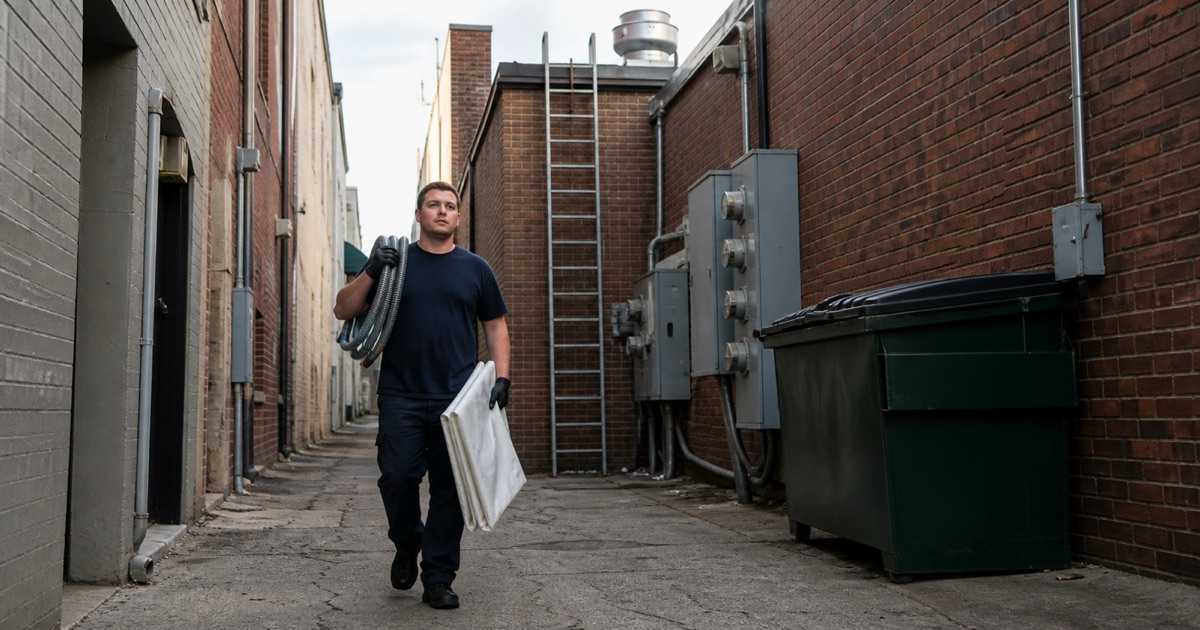
Shared Walls and Almost No Service Space
A shared-wall storefront in a historic district typically has no rear yard, no loading area and no space to stage a truck. Access is from a street frontage, a narrow shared alley, or occasionally through the building itself.
That constraint sets the timing more than the size of the system does. A short duct run reached through a difficult alley is a longer job than a long run with a parking space beside it, and pricing that honestly means looking at the site rather than the drawings. We quote from a visit here rather than from a description over the phone. A description of an Old Towne kitchen never conveys what the alley behind it is like.
Rooftops on Small Older Buildings
Roof access on a one or two-story historic building is rarely straightforward, and the roof itself is often small, shared with neighboring units and carrying equipment installed at various times by various people. Working out which fan belongs to which tenant is a real step.
We identify equipment against the unit rather than assuming from position, because a fan a few feet from one tenant’s back door frequently serves the unit next door. Getting that wrong means cleaning somebody else’s equipment and billing the wrong operator for it. On a shared historic roof that mistake is easier to make than it sounds. Units have been subdivided and combined over a century and the equipment reflects that.
Duct Routed Through Buildings Never Designed for It
Kitchens fitted into older buildings have duct threaded around existing structure rather than designed into the shell, so runs are longer, turn more often and collect deposits at every change of direction. Access openings are frequently too few or too far apart.
Sections that cannot be reached appear on our reports with the reason, which is what the standard expects rather than a silent omission. Most of them resolve to listed access panels quoted separately, and on a historic building that work needs planning rather than improvising. Anything affecting the exterior of a building in a district like this deserves a conversation first.
The work is routine; the setting is what requires care. A district of that age rewards contractors who ask before they act.
Looking for kitchen hood cleaning closer to Laguna Beach? See Laguna Beach Kitchen Hood Cleaning.
The Hospital Cluster
Kitchens That Run Continuously
The medical campuses in this city employ thousands of people between them and operate food service that does not stop. Patient meal service, staff cafeterias and around-the-clock operations leave no window in the sense a restaurant would understand.
We sequence the work in sections against the meal schedule, isolating and returning each part to service before opening the next. The total time is longer and the kitchen keeps running, which is the only arrangement a hospital can accept. The sequence is agreed with food service management rather than proposed on the night. Their meal schedule is the fixed point and everything else moves around it.
Documentation for Accreditation and Review
Hospital facilities departments produce records for accreditation, insurance and regulatory review, and they are asked for them far more often than commercial operators are. Measured grease depth, photographs filed by area and a written exceptions list are what those files require.
We keep every report and reissue it on request rather than for a contract term. In an organization of that size the person who commissioned the work is rarely the person who later needs the paperwork. A record that requires a phone call to interpret has already failed. The person calling usually has a deadline and no context.
Scale and Sequencing Across a Campus
A medical campus may run several kitchens across multiple buildings with different schedules and different management. Treating them as one account with one visit date does not work.
We plan across the campus rather than per building, sequencing so no two dependent kitchens are offline together. That is a scheduling problem more than a technical one, and it is where most of the value is on an account of that size. Getting the order right saves more than any efficiency in the cleaning itself. On a multi-building campus the sequence is most of the job.
Interval, Authority and Practical Handling
Banding on What Each Kitchen Cooks
The fire code bands cooking volume rather than floor area — monthly for solid fuel, quarterly for high-volume operations including charbroiling, semi-annually for moderate volume and annually for genuinely low-volume kitchens.
A historic-district restaurant with a charbroiler and a hospital cafeteria are unlikely to share a band. We measure and set each interval from a reading, which is the only approach that survives contact with a city containing two markets this different. One schedule across both would misprice at least one of them badly.
It would also leave one of them under-served, which is the half that matters. Compliance risk does not average out across an account.
A City Fire Department
Orange runs its own fire department across several stations rather than contracting with the county authority, so plan review, inspection and hood suppression permitting go through the city. That is a genuine difference from most neighboring cities.
Records are written to be read by that department. Environmental health sits with the county agency, which posts a pass or closure notification rather than a letter card, so the two halves of the paperwork address two different readers. Writing for both is a small amount of extra care that pays off during an inspection. They rarely arrive on the same day and they never ask the same question.
Working Considerately in a Historic District
A historic district is a residential-adjacent environment with businesses close together and neighbors nearby, and late-night equipment noise carries. That is a practical constraint on overnight work rather than a regulatory one.
We plan the approach before arriving and keep the setup tight. Where a business can accommodate an early morning rather than an overnight, that is frequently the better answer for everyone including the neighbors who did not order the work. A complaint from a resident makes every subsequent visit to that street harder. Goodwill in a district like this is worth protecting deliberately.
What Each Visit Leaves Behind
Photographs Filed by Area
The cleaning ends with photographs of bare metal taken at the surface, organized by section so the hood, plenum, duct and fan each carry their own evidence. A single wide shot of a clean hood proves nothing about a run threaded through an older building.
On a shared-wall storefront that structure also settles which system was actually worked on. Where several units share a roof and equipment has accumulated over decades, a photograph tied to a named section is worth more than any description. Descriptions of rooftop equipment in a district like this are rarely precise enough to be useful. A photograph settles what a paragraph cannot.
Depth Recorded as a Figure
Grease depth is measured with a comb and written down, against roughly 2,000 micrometers as the point NFPA 96 treats as requiring cleaning and about 50 micrometers as the standard the work reaches.
For a hospital facilities team tracking multiple kitchens, comparability is most of the value. A figure lets this visit be read against the last one by somebody who attended neither, which is how an interval gets corrected on evidence. Correcting it on impressions is how it stays wrong for years. Impressions drift; a number does not.
Exceptions Written Down
Anything not reached is named with the reason. On historic-district buildings with retrofitted duct that list is often longer than average, and reporting it honestly is more useful than a clean-looking report nobody can rely on.
Each item converts into priced work rather than a recurring note. Listed access panels fitted once turn an unreachable run into a normal section, and on a small building that work is best planned rather than squeezed into an overnight window. Planned properly it happens once and never appears on a report again. That is the outcome worth paying for rather than a slightly cheaper cleaning.
- 20+ Years in Orange County
- Overnight & Between Services
- Photographed to Bare Metal










