
Irvine Kitchen Hood Cleaning sequences kitchen hood cleaning in Rancho Santa Margarita as a route, since the city’s kitchens are spread across roughly a dozen small centers rather than gathered into a downtown. The defining feature of this market is that it has no single center of gravity, and the commercial cooking is distributed across roughly a dozen named neighborhood and community centers rather than concentrated in a downtown. That geography shapes how the work is planned far more than the systems themselves do.
Alongside the retail sits a substantial light-industrial and business-park base, considerably larger than most cities of this size carry. Those buildings bring their own kind of food service — employee dining, contract catering and the occasional full production kitchen — and they buy through facilities management rather than through a chef. The two halves of the market want quite different things from a contractor.
We work the city as a route rather than as a series of unrelated appointments, because that is the only arrangement that makes sense when a dozen small centers are involved. The alternative is a schedule that spends more time relocating than cleaning, and one that slips within a month of being agreed.
Kitchens Spread Across Many Small Centers
Route Density Rather Than a Downtown
A city whose restaurants sit in a dozen separate centers is a different proposition from one with a single dining district, even when the total number of kitchens is similar. Each center is its own access arrangement, its own staging problem and its own set of neighbors. Planning the sequence properly is worth more here than a marginal difference in the price of any individual visit.
We establish the route before quoting rather than pricing each kitchen as though it stood alone. Where an operator runs more than one site in the city, sequencing them across a night frequently costs less than servicing them separately across a month. That is a conversation worth having at the start, because it changes the shape of the whole arrangement rather than a line on the invoice.
Neighborhood Centers and Their Shared Roofs
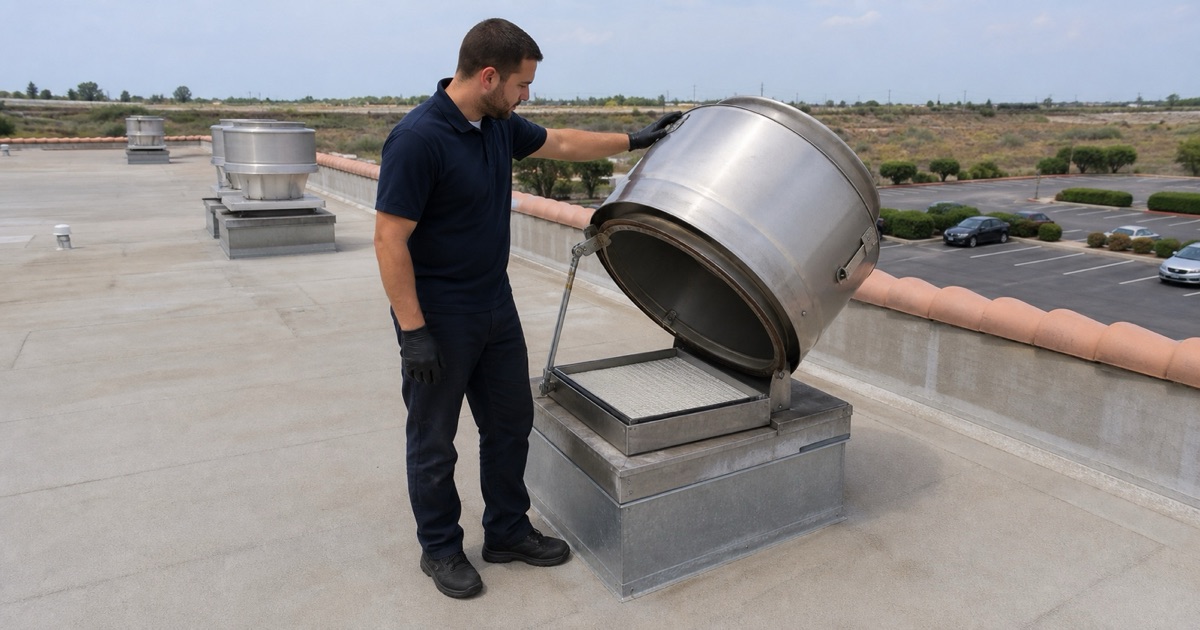
Most of these centers are single-story multi-tenant buildings with a continuous roof plane and rooftop equipment for several tenants sitting close together. Access is generally straightforward, which is the good news, and identifying which fan belongs to which unit is a genuine step rather than a formality. A fan a few feet from one tenant’s back door frequently serves the unit beside it.
We identify equipment against the unit rather than inferring it from position, because getting that wrong means cleaning somebody else’s system and billing the wrong operator for it. On a shared roof plane the containment underneath one fan does nothing for the one next to it either. Both are worth checking on every visit rather than assumed from the last one.
Cuisine Mix Across a Distributed Base
The city publishes a broad restaurant roster across its centers, and the cooking varies widely from casual chains to kitchens running woks and tandoor ovens. That variation matters technically rather than descriptively, because high-heat and high-fat cooking sit in a shorter interval band than a sandwich operation does. Two units in the same center can genuinely belong on different schedules.
We band each kitchen on the equipment that actually runs rather than applying a center-wide interval for convenience. That means measuring rather than assuming, and it means telling an operator plainly where they land even when the answer is not the one they were expecting. The reading is the same whichever way it points.
Looking for kitchen hood cleaning closer to Fountain Valley? See Kitchen Hood Cleaning Services in Fountain Valley.
Business Parks and Industrial Food Service
Employee Dining and Contract Catering
The city’s light-industrial base is substantial, and the larger operations within it carry employee dining rooms, contract catering or cafeteria service. Those kitchens peak on weekdays and go quiet, which is a different loading pattern from a restaurant and a considerably wider service window. Scheduling around them is easier than scheduling around a dining room that trades every evening.
The buyer is also different. A facilities manager wants an interval that holds without chasing, a compliance file that is current and a report that survives an audit, rather than the lowest price on a single visit. We write records in that form as standard, because that is what makes an account straightforward to renew rather than something to re-tender.
Production Kitchens in Industrial Buildings
Some industrial premises carry genuine production kitchens rather than warming facilities, and those concentrate substantial volume into a small number of hoods. Volume of that kind loads a system faster than the size of the building suggests, and the duct runs in industrial shells are often longer than they look. Both push the interval shorter than an operator might expect.
We measure grease depth rather than estimating it, and we map the accessible sections before quoting. In a large shell the run can travel a considerable distance before reaching a roof, and the number of access openings along it decides both what can be cleaned and what has to be reported as unreachable.
Institutional and Community Food Service
The city also carries community, recreational and institutional food service that cooks against a calendar rather than a daily service. A facility running events in bursts is misrepresented by an averaged schedule in both directions, because a fortnight of heavy use is nothing like a fortnight of an empty room. Those accounts are scheduled against the calendar instead.
That approach requires the calendar, which is usually available well in advance once somebody asks for it. Cleaning ahead of a busy period is worth considerably more than cleaning partway through one, and it is a straightforward conversation to have with a facility that plans its year.
Interval, Authority and Utilities
Banding on What Comes Off the Line
The California Fire Code bands by cooking volume — monthly for solid fuel, quarterly for high-volume operations including charbroiling and wok cooking, semi-annually for moderate volume and annually for genuinely low-volume kitchens. Floor area, seat count and menu length decide none of it, which is the most common misunderstanding we correct.
Applying one interval across a distributed account is a scheduling convenience rather than a code position, and in a city with this range of cooking it is wrong for most of the kitchens in it. We measure and band each one, then sequence the route around the intervals rather than the other way round.
Orange County Fire Authority
Rancho Santa Margarita is an OCFA member city, so plan review, inspection and the Guideline D-02 frequency banding all run through that authority rather than a municipal department. That gives the whole city one consistent set of expectations, which is genuinely helpful when an account spans several centers.
Records are written to be read by OCFA and by Orange County Health Care Agency on the environmental health side. The health agency posts a pass or closure notification rather than an A, B or C card, so any copy promising to protect a grade here was written for a different county entirely.
Water District and Grease Requirements
Fats, oils and grease requirements for food facilities here run through the local water district rather than through the city, which is a different arrangement from several neighboring cities. Wash water and degreaser are captured rather than pushed toward a floor drain, both because that is the correct handling and because the alternative fills an interceptor at the operator’s expense.
That second cost is invisible on the night and obvious two months later, when an interceptor needs pumping earlier than budgeted and nobody connects it to the cleaning that caused it. We capture at source and say why, because an operator paying twice for one job deserves to know it is avoidable.
What Each Visit Leaves Behind
Photographs Taken at the Surface
Every cleaning ends with photographs of bare metal taken where the metal actually is, filed by area so the hood, the plenum, the duct and the rooftop fan each carry their own evidence rather than sharing one representative image. A wide shot of a clean hood establishes nothing about a run above a ceiling, and it is the photograph most commonly supplied by contractors who did not open one.
On an account spread across a dozen centers that structure is what makes the records comparable. It lets an operator look at two of their own sites side by side and see the same sections documented the same way, rather than trying to reconcile two different ideas of what a service report should contain.
Grease Depth Recorded as a Figure
Depth is measured with a comb at defined points through the system and written down as a number rather than described in adjectives. NFPA 96 treats roughly 2,000 micrometers as the point at which a system requires cleaning, and a completed cleaning brings the surface down to around 50 micrometers.
Numbers are what allow one visit to be read against the last one by somebody who attended neither, which is the only practical way an interval ever gets corrected on evidence. A depth climbing steadily between visits says the schedule is wrong long before an inspector does, and it says it in a form nobody has to take on trust.
Anything Not Reached, Named in Writing
Sections that could not be cleaned are listed with the reason they could not be reached, because the standard expects that rather than a silent omission that reads as a completed job. In a city of newer purpose-built centers that list is usually short, which is itself worth knowing.
Every item on it is a priced fix rather than a permanent condition. Most resolve to a listed access panel or a hinge kit, after which the section is cleaned like every other and stops appearing on report after report for the life of the tenancy.
- 20+ Years in Orange County
- Overnight & Between Services
- Photographed to Bare Metal










