
Irvine Kitchen Hood Cleaning has cleaned restaurant exhaust systems in Irvine, CA for 20+ years, serving surrounding cities including Tustin, Laguna Woods, Lake Forest, North Tustin and Aliso Viejo. Restaurant hood cleaning here means the whole system rather than the visible end of it: filters, hood interior, plenum, horizontal duct, vertical riser and the rooftop fan, cleaned back to bare metal and photographed at the surface where the metal actually is.
Restaurants are the kitchens the frequency bands in the California Fire Code were written around. A line running a charbroiler through every dinner service loads a system in a way a warming kitchen never will, and the interval that follows from that is a technical question rather than a commercial one. We band the account on the equipment that runs, ask directly about solid fuel and woks, and tell you where that puts you before quoting anything.
The second thing a restaurant needs from this work is a record it can produce months later. A correction notice, a carrier’s question after a claim, or a change of ownership all arrive long after the crew has gone, and by then the only thing that still exists is the paperwork. Ours is written to be read by somebody who was never in your kitchen.
What a Restaurant Hood Cleaning Covers
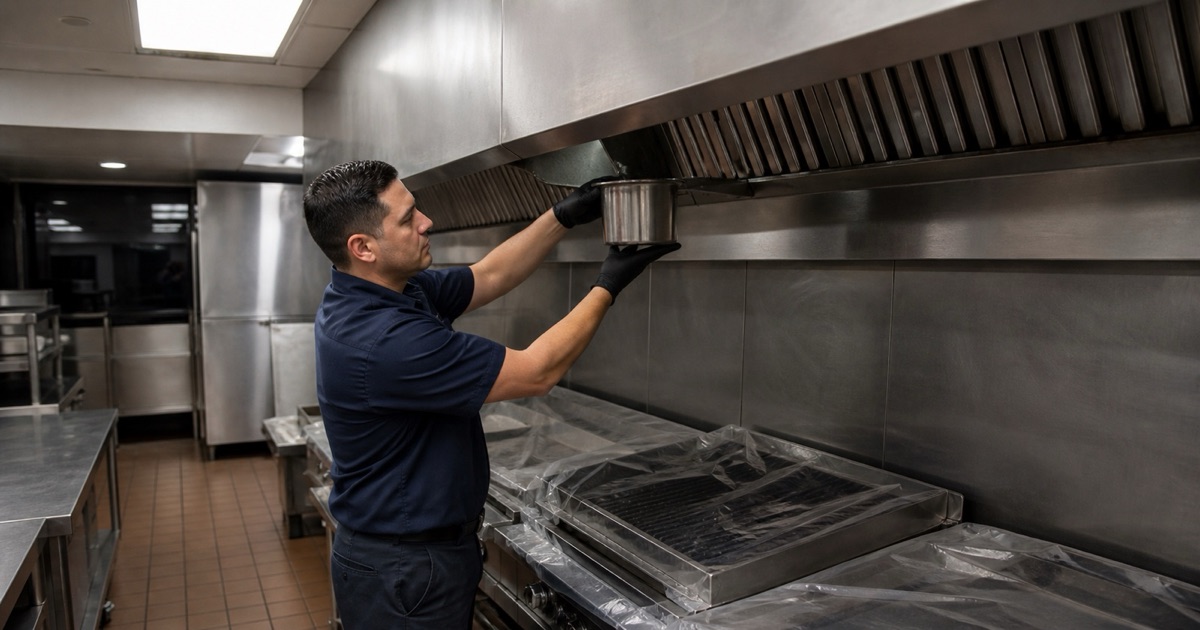
Filters, Hood Interior and Plenum
Baffle filters come out first, and the plenum behind them is cleaned on every visit without exception. That chamber loads faster than anything else in the hood because it is the first place the vapor slows down and gives up what it is carrying. It is also the section that vanishes completely the moment clean filters are slotted back into place, which is precisely why a quote that looks cheap has so often stopped at the hood face. You cannot inspect it from the cook line, and nobody who skips it expects to be asked.
Horizontal Duct and Vertical Riser
Duct running above a ceiling and riser climbing inside a shaft hold most of a system’s fuel load and almost none of its visibility. We open them at their existing access points and clean the length of the run rather than the reachable end nearest the hood. A system judged on how its hood looks is being judged on a small fraction of what would actually carry a fire, and that fraction is the part a fire never starts in. Where a run has no opening at all, it goes on the exceptions report rather than into a certification.
The Rooftop Fan and Its Curb
The upblast fan tilts back on its hinge kit so the wheel, the housing interior and the curb underneath can all be reached. Grease pools under a fan that has never been lifted, and on an older system that pool is often the single heaviest deposit anywhere in the building. We clean it, set the fan back down onto its hold-open retainer so nothing is left resting on its wiring, and service the containment box and absorbent pad while we are still on the roof.
Cook Line Equipment and What It Does to the Interval
Charbroilers and Solid Fuel
A charbroiler is usually the biggest single escalator on a restaurant line, and wood or charcoal moves a kitchen into the shortest band in the table because it lays down creosote as well as grease. Solid fuel cooking frequently requires its own dedicated exhaust system rather than sharing one, which is a design question as much as a cleaning one. It is also the detail most often left off an inquiry, sometimes because the operator does not think of a pizza oven as solid fuel, so we ask about it directly rather than waiting to find it.
Woks and High-Heat Stir Frying
Orange County Fire Authority Guideline D-02 names wok cooking alongside 24-hour cooking and charbroiling in its high-volume band, and OCFA’s public guidance separately names stir frying as a reason to clean more often than the baseline. A wok line puts aerosolized oil into a plenum at a rate a flat top does not approach, and it does it in a fine mist that travels well past the hood into the duct. Where a kitchen runs woks daily, the interval follows the cooking rather than the calendar, and pretending otherwise is how a system ends up loaded between visits.
Fryers, Flat Tops and Steam
Fryer-heavy kitchens load a system faster than their footprint suggests, because fryer vapor is fine, buoyant and carries a long way down a duct run before it condenses. Flat tops and griddles sit in the middle of the range and behave predictably. Equipment producing only heat and steam under a Type II hood is a different obligation altogether, and we will tell you plainly when a hood does not need this service rather than selling you a cleaning the code never asked for.
Scheduling Around a Restaurant That Cannot Close
Overnight and Between Services
Most of this work happens overnight or in the gap between lunch and dinner, because no restaurant can give up a cover to a cleaning and none should be asked to. We agree the window before the quote goes out rather than after, so the schedule is part of the price rather than a negotiation once the crew is standing in your kitchen. Equipment is back in service, the line is wiped down and the floor is dry before your first prep shift arrives.
Containment and Protecting the Line
The cook line, the floor and every surrounding surface are contained before any water moves anywhere. Degreaser and wash water are captured rather than pushed toward the nearest floor drain, which matters both for your grease interceptor and for whichever agency runs the fats, oils and grease program in your particular city. In Irvine that is the Irvine Ranch Water District, and it is not the same body in every city we work in, which is a good reason not to assume.
What Happens to the Filters
Filters are cleaned properly or exchanged rather than run through your three-compartment sink, where they tie up staff for an hour, rarely come genuinely clean and send everything they were holding straight into the drain line. Baffle filters listed under UL 1046 are built to drain captured grease back into a cup by design, which is the whole point of the geometry. Mesh filters saturate, clog and then drip onto the cook line below, which is why a number of jurisdictions do not permit them over commercial cooking equipment at all.
The Record You Are Left With
Bare Metal, Photographed by Area
Photographs are taken before, during and after the work, and filed by area of the system rather than presented as a single flattering shot of whichever panel came up best. The hood, plenum, duct and fan each carry their own evidence, because a wide photograph of a clean hood proves precisely nothing about a riser two floors above it. Bare metal is the trade’s actual acceptance standard rather than a marketing phrase, and photographs are how you verify it instead of taking it on trust from somebody who has already left.
Measured Depth Instead of Adjectives
Grease depth is measured with a comb and the reading is written down. NFPA 96 treats roughly 2,000 micrometers as the point at which a system requires cleaning, and the cleaning itself works the surface down to about 50 micrometers. A number survives a change of general manager, a change of ownership and an insurance review; “the system looked dirty” survives none of those, and it is not something a later reader can do anything with.
What We Could Not Reach, in Writing
Any section we could not clean is named with the reason it could not be reached, because NFPA 96 expects exactly that rather than a silent omission that reads as completeness. In most cases the answer is a listed access panel installed on the run, which we quote separately so the same gap does not reappear on every future report for the next decade. A report showing no exceptions at all on an older system usually means nobody actually opened it, and that is worth knowing about whoever wrote it.
- 20+ Years in Orange County
- Overnight & Between Services
- Photographed to Bare Metal