
Irvine Kitchen Hood Cleaning installs and services rooftop grease containment in Irvine, CA and the surrounding cities including Tustin, Costa Mesa, Anaheim, Buena Park and Fullerton. Containment sits under the exhaust fan discharge to catch what the system throws out before it reaches the roof, and it is the one part of this trade bought by the building owner more often than by the kitchen.
The reason is straightforward. Grease degrades single-ply roofing membranes and commonly voids roofing warranties, and that exposure sits with whoever owns the roof. A tenant can cook for years without ever going up there, while the cost of what has accumulated lands on somebody else entirely.
It is also the part of this trade most often absent altogether. A fan installed twenty years ago on a building that has changed hands twice frequently has nothing underneath it at all, and nobody currently involved knows whether it ever did.
What Containment Does and Why It Matters
Boxes, Pads and How They Work
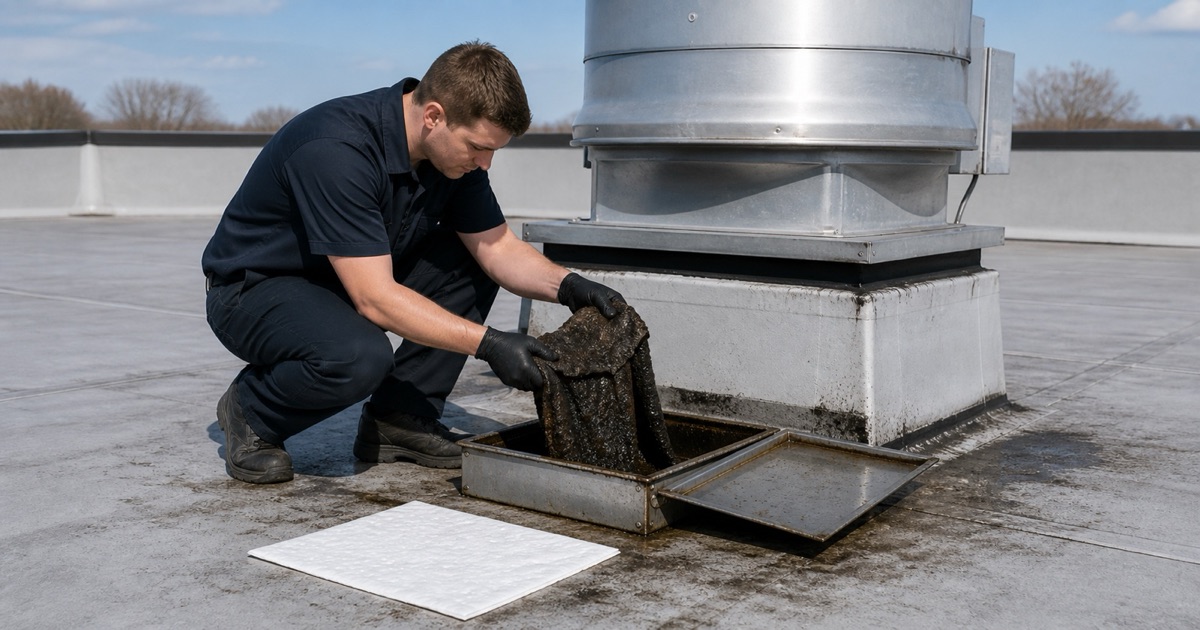
A containment unit sits beneath the fan discharge and holds absorbent pads that capture grease before it can spread across the membrane. The pads are consumables with a finite capacity. A saturated pad is not containing anything, and a unit that has never been serviced is producing the appearance of protection rather than the substance of it. That distinction matters most at exactly the moment somebody is deciding whether a warranty claim will be honored.
Membrane Damage and Roofing Warranties
Single-ply membranes such as TPO, EPDM and PVC degrade on contact with cooking grease, and roofing warranties routinely exclude damage caused by it. That turns an unmanaged fan discharge into a warranty problem long before it becomes a leak. Establishing that containment is in place and serviced is often what keeps a warranty conversation from going badly, because the roofer’s first question is always how long the discharge has been running unmanaged over their product.
Who Actually Carries the Exposure
Whether the landlord or the tenant is responsible depends on the lease, and commercial restaurant leases vary widely on exhaust maintenance. What does not vary is that the damage happens to the owner’s asset. We photograph roof condition around the fan on every visit so the question is settled from dated evidence rather than argued from memory once there is a repair bill attached.
Installing and Servicing It Properly
Sizing and Fitting to the Fan
Containment is fitted to the fan and the curb rather than dropped near it, because a unit that does not sit correctly under the discharge simply diverts the problem a few feet sideways. We size to the fan and check the fit while the fan is lifted for cleaning, which is the only moment the geometry is genuinely visible. Fitting containment from the roof deck with the fan seated is guesswork, and it is why so many units sit slightly off the discharge they were bought to catch.
Servicing on the Cleaning Cycle
Pads are inspected and replaced on the same visit as the exhaust cleaning, so containment stays on a schedule rather than becoming something nobody owns. Where a kitchen’s cooking volume loads the system quickly, the pads need changing more often than the duct needs cleaning, and we will say so rather than letting them run to saturation between visits. Pads are inexpensive; a membrane repair is not, and the gap between those two numbers is the entire argument for the service.
Cleaning Up What Has Already Escaped
Where grease has already spread across the membrane, containment alone does not fix it. Removing existing contamination is separate work, and on a roof that has gone years without containment it can be substantial. We assess and quote it honestly rather than fitting a box over an existing problem and calling the matter closed.
Containment in the Service Record
Documented on Every Visit
Containment condition, pad saturation and the state of the roof around the fan go into the same report as the cleaning, with dated photographs. That record is what makes containment a managed item rather than a box somebody remembers installing. It is also what a building owner needs when the roofer asks how long grease has been reaching the membrane.
Settling the Landlord and Tenant Question
Because the record is dated and photographic, it turns a dispute about who let the roof get into that state into a question with an evidence trail. We are not a party to the lease and we do not adjudicate it. What we can do is make sure neither side is arguing from memory, which is usually where these conversations go wrong.
Where Containment Is Not the Answer
A discharge pointed at a parapet, a fan sitting in a low spot where water and grease collect, or a unit that was never sized for the fan are design problems that containment manages rather than solves. We will say when that is what we are looking at. Fitting a larger box under a badly placed fan is spending money to postpone a roofing conversation.
- 20+ Years in Orange County
- Overnight & Between Services
- Photographed to Bare Metal