
Irvine Kitchen Hood Cleaning files kitchen hood cleaning in Santa Fe Springs with one municipal office, because the city’s own fire department also administers its industrial waste permitting. Santa Fe Springs is a working city rather than a residential one, and its food economy exists to feed a daytime workforce rather than a dining public.
The imbalance is stark. The city carries many times more jobs than housing units, and that ratio is far above the county average. What that produces is weekday-peaked, lunch-oriented food service — quick-service, counter operations and catering — rather than an evening restaurant trade.
The rhythm of the city decides the rhythm of its kitchens. Weekday-peaked demand is easier to service than an evening trade.
It also has an administrative feature that exists nowhere else in our service area. The city runs its own fire department, and that same department’s environmental protection function handles the city’s industrial waste permitting. The fire inspector and the grease permit come from one municipal office rather than two separate bodies.
That consolidation is genuinely unusual and worth understanding. Most cities split those functions across two or three separate bodies.
One Department for Fire and Grease
A City Fire Department, Not the County
Santa Fe Springs operates its own Department of Fire-Rescue rather than contracting with the county fire department that serves several neighboring cities. Plan review, hood suppression permitting and inspection all run through that municipal department.
That is worth establishing before anybody files paperwork, because contractors working across this part of the county will be accustomed to a county authority. Records addressed to the wrong body are not merely untidy — they suggest nobody checked where the property sits. In a city with its own department, that check is the first thing to do. It takes one look at the address and settles both questions at once.
The Same Office Handles Industrial Waste
The department’s environmental protection function administers the city’s industrial waste permitting and serves as its certified unified program agency. So the wastewater and hazardous materials side and the fire side sit within one organization rather than being split between a fire authority and a separate district.
For an operator that is genuinely simpler than the arrangement in most cities, where three separate bodies handle fire, health and grease. It also means the department seeing your exhaust system is connected to the one seeing your interceptor. Those two things are related in reality and rarely related administratively. Here they are related in both, which is unusual and useful.
What That Means in Practice
Consolidation of that kind rewards getting the paperwork right, because the same organization sees more of your operation than it would elsewhere. A consistent, well-documented cleaning history is more visible here rather than less.
We write records to be read by that department and keep them for reissue. Where one office holds several strands of a business’s compliance, a coherent file across all of them is worth more than a good record in one strand and nothing in the others. Consistency across the file is what a single department will notice. Gaps are equally visible for the same reason.
Looking for kitchen hood cleaning closer to Signal Hill? See Kitchen Hood Cleaning Services in Signal Hill.
A Daytime Workforce Food Economy
Weekday Lunch Rather Than Evening Trade
Food service supporting an industrial workforce peaks sharply at lunchtime on weekdays and falls away in the evening and at weekends. That is a different loading pattern from a restaurant and a considerably wider service window for this work.
It also means the buyer frequently thinks about the kitchen as a support function rather than as a business in itself. Those operations benefit most from having an interval somebody actually owns, because otherwise the schedule drifts until something forces attention. Support functions drift precisely because nobody’s job depends on them. An owned interval is the whole remedy.
Quick-Service and Counter Operations
Much of the provision is quick-service and counter-format, which loads a system faster than the footprint suggests where fryers are involved. Fryer vapor is fine and travels well past the hood before condensing, so the duct beyond loads even where the hood looks manageable.
We measure depth along the system rather than judging from the visible end. A compact counter operation running fryers through a lunch rush can sit further up the frequency table than a larger kitchen with a simpler line. Footprint is a poor predictor and equipment is a good one. A fryer bank in a small unit outranks a large kitchen without one.
Catering and Off-Site Production
An industrial city with limited on-site dining generates demand for catering and off-site production instead, and production kitchens serving multiple locations concentrate substantial volume into a small number of hoods.
That volume is easy to underestimate because the building looks like a unit rather than a restaurant. We band on what the line actually produces rather than on the type of premises it sits in, which is the assumption most likely to be wrong here. An industrial unit can contain a kitchen producing more than a restaurant does.
Nothing about the outside of the building indicates that. Industrial shells give away nothing about what is cooking inside them.
Industrial Premises and Access
Large Shells and Long Runs
Kitchens inside industrial buildings frequently have longer duct runs than their scale suggests, because the cooking sits somewhere convenient and the discharge has to reach a roof that may be some distance away. Long runs turn more often and collect at every change of direction.
We map the accessible sections before quoting rather than after. The number and position of access openings decides what can genuinely be cleaned, and on a retrofitted industrial run those openings are frequently too few. Long runs with few openings are the classic source of unreachable sections. Closing them is a one-time cost against a recurring exception.
Access, Staging and Site Rules
Industrial sites have their own access arrangements, security requirements and permitted working hours, and those are set by site management rather than by the kitchen. Establishing them before the night is a scheduling step rather than a formality.
We confirm each site’s requirements individually rather than generalizing from another one. Requirements differ between operators and sometimes between buildings on a single site, and a crew held at a gate is a wasted mobilization somebody pays for. Confirming individually takes one call and prevents that entirely. It is the cheapest call on the whole account.
Roofs and Rooftop Equipment
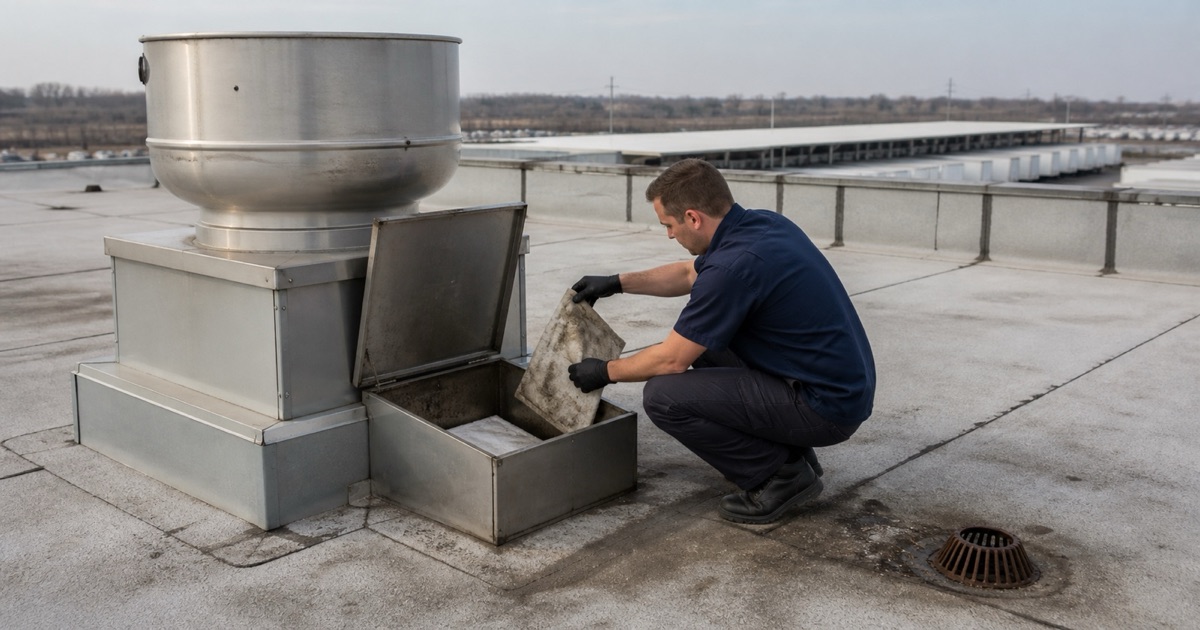
Industrial roofs are generally accessible and offer room to work, which is the easiest condition this trade encounters. Grease containment beneath the discharge still needs checking on every visit rather than being assumed from a previous one.
Grease reaching a roof membrane is the building owner’s exposure rather than the kitchen’s, and on a leased industrial building that distinction matters. We photograph roof condition around the fan so the question can be settled from evidence rather than argued from memory. On a leased industrial building that evidence is worth having before it is needed. Landlord conversations go better from photographs than from recollection.
Authority, Interval and Records
Los Angeles County Health and Grade Cards
Environmental health here sits with the Los Angeles County Department of Public Health, and this city adopted the county grading ordinance, so food facilities display an A, B or C card publicly. That is the arrangement across this part of the county.
It is genuinely different from the position in Orange County a short distance south, where a pass or closure notification is posted and no letter grade exists. We establish the county from the address rather than assuming from a neighboring city. The line runs closer to some of these addresses than operators realize. A few blocks changes both the health authority and the placard.
Banding on What Comes Off the Line
The fire code bands cooking volume — monthly for solid fuel, quarterly for high-volume operations including charbroiling, semi-annually for moderate volume, annually for genuinely low-volume kitchens. The type of building decides none of it.
A production catering kitchen inside an industrial shell and a small counter operation belong in different bands. We measure and band each individually rather than applying an assumption about what industrial food service ought to need. Industrial premises produce a wider range of cooking than their appearance suggests.
We measure rather than assume for exactly that reason. The reading takes minutes and removes every argument about the interval.
What Each Visit Leaves Behind
Every cleaning produces measured grease depth recorded as a number, photographs filed by area of the system, and a written list of anything that could not be reached with the reason it could not be reached.
We keep those records and reissue them on request indefinitely. Where one municipal department sees both the fire and the wastewater side of a business, a consistent documented history across visits is worth more than it would be in a jurisdiction with the functions split. A single reader notices patterns that two separate readers never would. That cuts both ways and is worth being on the right side of.
- 20+ Years in Orange County
- Overnight & Between Services
- Photographed to Bare Metal










