
Irvine Kitchen Hood Cleaning arranges kitchen hood cleaning in Stanton through a single point of contact, because fifteen of the city’s restaurant kitchens sit inside one food hall under one landlord. Stanton is a small city with a commercial-kitchen concentration well out of proportion to its size, and most of that concentration sits in one place under one owner.
A food hall of roughly forty thousand square feet holding fifteen restaurant kitchens plus a brewery and a full bar is a different commercial proposition from fifteen restaurants spread along a street. There is one landlord, one management relationship and one schedule to agree, rather than fifteen separate negotiations with fifteen operators who each close at a different hour.
That concentration is why this city earns its place on our service area despite its population, and it is a useful reminder that commercial kitchen density and resident population are not the same measure. A city of this size with a food hall in it outranks a considerably larger bedroom suburb without one. Population is simply the wrong instrument for measuring this market.
Commercial kitchen count is the only measure that predicts anything here. A food hall changes a city’s profile more than ten thousand residents would.
Many Kitchens, One Landlord
Scheduling Through a Single Point of Contact
When fifteen kitchens sit under one owner, the work is arranged once rather than fifteen times. Access, staging, permitted hours and the order of work are all agreed with a single management contact, and that agreement then repeats every cycle without renegotiation.
That is a genuine efficiency and it belongs in the price rather than in our margin. A coordinated night through several units costs each of them less than a separate mobilization would, and it means the roof is opened once rather than repeatedly across a month. Landlords notice that difference as much as tenants do. Repeated roof access is disruptive to a whole property rather than one unit.
Doing it once is worth arranging properly. A single coordinated night beats a month of individual visits for everyone involved. Tenants, landlord and crew all come out ahead of the alternative. That alignment is unusual enough to be worth organizing deliberately.
Documenting Tenant by Tenant Regardless
Coordination is about how the work happens. The record still has to be specific to the unit that paid for it, because an inspector asks an individual operator about their own kitchen rather than about the building they happen to be in.
We document by tenant and by system so responsibility stays legible after leases turn over. In a food hall format, tenants change faster than ductwork does, and a record keyed to a unit survives that while a building-wide report does not. The next operator inherits a documented system rather than a mystery. That is worth something at handover and worth more at an inspection.
Tenant Turnover and Inherited Systems
Food hall units turn over more often than most restaurant formats, and each incoming operator inherits whatever the previous one left above the ceiling. A unit can change hands twice without anybody opening the duct serving it.
An inspection at handover establishes what condition that system is actually in and what it will cost to bring to a cleanable state. It is a small cost against a lease and it is the piece of due diligence that gets skipped until there is no leverage left to use it. Once the lease is signed the condition of the duct is the new tenant’s problem. Before it is signed, it is a negotiating point.
Looking for kitchen exhaust system cleaning closer to Fullerton? See Kitchen Exhaust System Cleaning Services in Fullerton.
Cooking Variety Under One Roof
Different Bands in One Building
A food hall assembles operators cooking in genuinely different ways — grills, fryers, woks and simple assembly kitchens can all sit within a few feet of each other. The fire code bands cooking volume rather than address, so those units do not belong on one shared interval.
We band each kitchen separately and then sequence the visit so the building is still serviced efficiently in one night. That is the arrangement that satisfies both the code and the landlord, and it is more work to plan than a single blanket schedule. Planning it once means it then repeats without further effort.
Shared Structure and What It Implies
Kitchens inside a single envelope share a building, a roof and sometimes structure, which raises questions about where one unit’s system ends and common infrastructure begins. Those questions are best settled before a cleaning rather than during an invoice discussion afterward.
We establish the route of each system before quoting rather than assuming from the hood. Where a section is genuinely common, it needs an owner named before anybody can reasonably be billed for it, and that is a conversation for the landlord rather than the tenant. Settling it early avoids an argument at the point of invoicing.
Corridor Restaurants Beyond the Food Hall
The city also carries restaurant and retail-center kitchens along its main commercial corridor, mostly in single-story multi-tenant buildings with straightforward roof access. Those are conventional accounts serviced conventionally.
Sequencing them alongside the food hall visit is usually the efficient arrangement, since the city is compact enough that relocation costs little time. We plan the city as a route rather than as unrelated appointments for that reason. A compact city rewards sequencing far more than a spread-out one does. Setup time dominates when the driving time is measured in minutes.
Authority, Interval and Handling
Orange County Fire Authority
Stanton is an OCFA member city, and the unincorporated county islands within the city are also served by OCFA, so the fire authority is consistent across every address here. Plan review, inspection and the Guideline D-02 banding run through that authority.
Environmental health sits with Orange County Health Care Agency, which posts a pass or closure notification rather than an A, B or C card. Records are written to be read by both bodies, since each asks a different question about the same kitchen. One is concerned with grease and the other with ventilation and surfaces.
What Each Visit Documents
Every cleaning produces measured grease depth recorded as a number, photographs filed by area of the system, and a written list of anything that could not be reached with the reason it could not be. Those three things answer nearly every question anybody subsequently asks.
For a landlord holding records across fifteen tenancies, consistency of format is most of the value. It lets one unit be compared against another and one visit against the last, without anybody having to reconcile two contractors’ different ideas of a service report. Consistency across a portfolio is most of what a landlord is buying.
Grease, Wastewater and Capture
Fats, oils and grease requirements here run through the city’s public works function, administered on the city’s behalf, rather than through a separate sanitary district. That is a different arrangement from some neighboring jurisdictions and worth confirming from the address.
Wash water and degreaser are captured at source rather than sent toward a floor drain. In a shared building that matters more than usual, because a single interceptor may serve several tenants and the cost of an early pumping falls on all of them.
Access, Timing and Practical Constraints
One Roof, Many Tenants, One Night
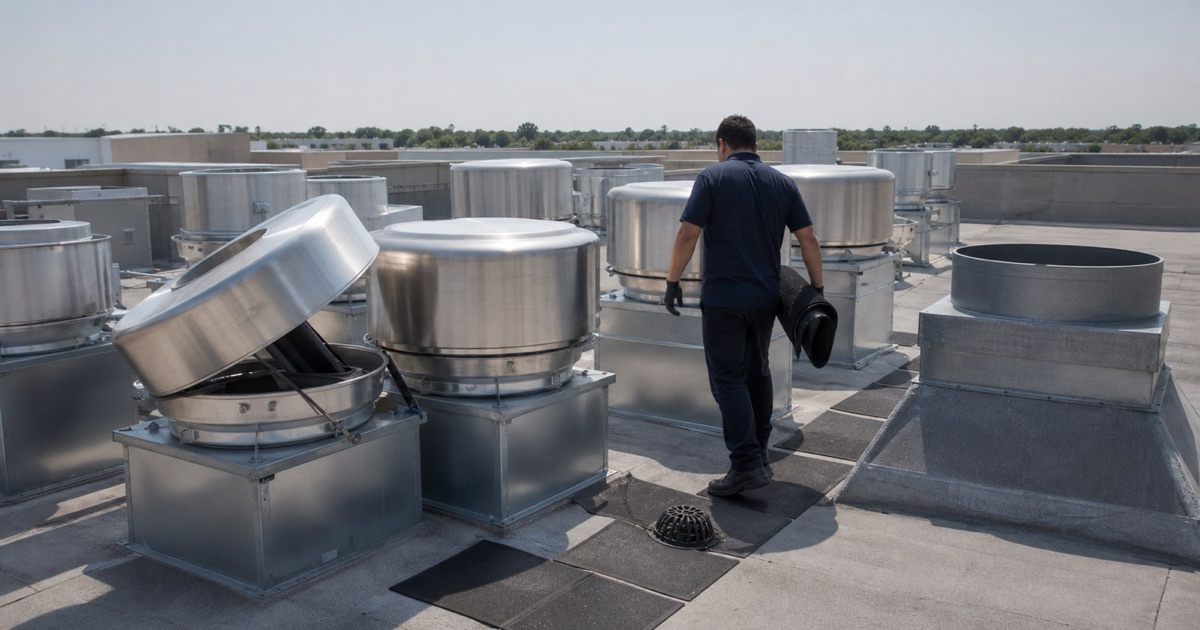
A food hall roof carries equipment for a large number of small kitchens in close proximity, and the efficient arrangement is to open it once and work through the units in sequence rather than returning repeatedly. That requires agreement from management rather than from each tenant separately.
We agree access, staging and permitted hours once and work within them on every subsequent visit. Individual operators are then not negotiating roof access each cycle, which is the main practical benefit of a single-landlord arrangement.
Working Around Different Closing Times
Fifteen kitchens under one roof do not close at the same hour, and a brewery and a bar keep different hours again from a food operator. Sequencing the work so each unit is cleaned after it closes takes planning rather than an assumption that the building empties at once.
That sequence is agreed in advance and shared with the tenants rather than sprung on them. A tenant who knows their kitchen will be worked on at one in the morning can prepare for it; one who does not will find a crew in their unit unexpectedly.
Containment in a Shared Building
Containment matters more in a shared envelope than in a standalone restaurant, because anything that escapes affects neighboring units rather than only the kitchen that generated it. Wash water, degreaser and debris are all contained before anything runs.
We also capture at source rather than sending anything toward a floor drain. Where a single grease interceptor serves several tenants, an early pumping is a cost shared by operators who had nothing to do with causing it. That makes capture at source a courtesy to the neighbors as well as correct practice.
In a shared building the neighbors are the people most affected by shortcuts. They are also the ones who report them.
- 20+ Years in Orange County
- Overnight & Between Services
- Photographed to Bare Metal










