
Irvine Kitchen Hood Cleaning handles kitchen hood cleaning in Tustin, where an unusual share of the cooking happens inside shared food-hall envelopes rather than in standalone restaurants. Tustin is an unusual market for this trade because so much of its cooking happens inside shared buildings rather than in standalone restaurants, and a shared building changes almost everything about how an exhaust system is serviced.
A food hall is not simply a row of small restaurants. It is a set of separate kitchens inside one envelope, frequently sharing structure, sometimes sharing runs, and always sharing a roof. That means the work has to be coordinated across tenants who each have their own hours, their own landlord relationship and their own idea of when the kitchen is closed.
We work the city’s food hall kitchens, its Old Town storefronts and its campus and institutional kitchens on the same principle: the system gets cleaned from the filters to the fan discharge, the sections that could not be reached get named in writing, and the report is written for whoever reads it next.
Kitchens Inside a Shared Envelope
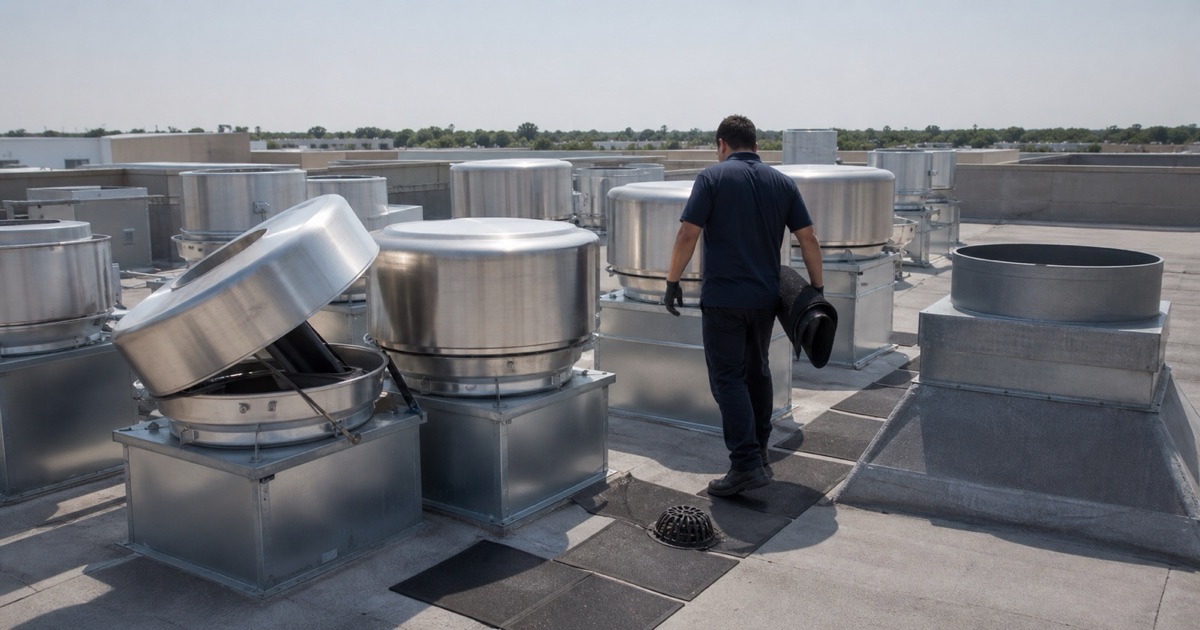
Many Tenants, One Building, One Roof
Tustin has two multi-tenant food hall operations, one at The District at Tustin Legacy and one at FLIGHT, and between them they put a large number of small kitchens into a small number of buildings. Each of those kitchens has its own exhaust obligation regardless of how the leases are drawn. The obligation follows the appliance line under the hood, not the square footage on the lease plan.
What changes in practice is scheduling. Ten tenants who each close at a different hour cannot be serviced as ten separate appointments without somebody being disturbed, so the sensible arrangement is one coordinated visit agreed with center management and worked through in sequence. Agreed once, that arrangement then repeats every cycle without anybody renegotiating it.
Where One Tenant’s Run Meets Another’s
In a shared envelope it is not always obvious from inside a unit where that unit’s duct actually goes, how far it travels, or what it passes through on the way. A tenant can be entirely confident about a system they have never seen more than two feet of. That confidence is not misplaced so much as untested, and it usually goes untested until an inspection.
We establish the route before quoting rather than after, because the length of the run and the number of access points decide the price and the time. On a shared building that is also the only way to say honestly which sections belong to whom. Guessing at that boundary is how two tenants each assume the other is paying for the same run.
Documenting by Tenant, Not by Building
A report that covers a whole building tells an individual operator very little, and it is useless to a tenant trying to answer an inspector about their own kitchen. We document by tenant and by system so responsibility stays legible after leases turn over and managers change.
That matters more in a shared building than anywhere else, because the people who signed the original arrangement are frequently gone by the time anybody asks a question about it. A record keyed to a unit survives that; a record keyed to a building does not. Leases turn over faster than ductwork does, which is the whole argument for keying it to the unit.
Looking for kitchen hood cleaning closer to Laguna Woods? See Kitchen Hood Cleaning Services in Laguna Woods.
Converted Buildings and What They Do to Ductwork
Ductwork in a Repurposed Structure
Tustin Legacy occupies the site of the former Marine Corps Air Station Tustin, and a good deal of the commercial development here involves buildings and sites adapted to uses they were not originally designed around. Adapted buildings tend to have adapted ductwork. Runs get threaded around structure that was already there rather than laid out to suit the kitchen.
Duct that has been rerouted around existing structure runs longer, turns more often and collects deposits at every change of direction. None of that is a defect. It simply means the cleaning takes longer and the access points matter more than they would in a purpose-built shell. Every additional turn is another place deposits collect faster than the straight sections either side of it.
Access Panels Added After the Fact
Where a run was fitted into a building rather than designed into it, access openings are often too few or too far apart to reach the middle of the run. That shows up on our reports as sections that could not be cleaned, which is the honest answer rather than a convenient one. A report that never carries an exception on a retrofitted run is describing a building nobody opened.
The remedy is listed access panels installed at the right spacing, quoted separately. It is a one-time cost against a section that would otherwise appear as an exception on every report for as long as the building stands.
Old Town’s Small Storefront Kitchens
Old Town Tustin is the other half of the city’s restaurant stock and behaves in the opposite way: small independent kitchens in older buildings, generally with short runs and constrained rear access. The systems are simpler and the working conditions are tighter. Short runs are quick to clean; a narrow alley with no staging room is what actually sets the timing.
Those kitchens are usually owner-operated, which means the person deciding on the work is also the person cooking. We schedule around service rather than around our own routing, because a small independent has no capacity to absorb a lost evening. One missed evening in a twelve-table room is a meaningful share of a week’s trade.
Institutional and Campus Kitchens
District and School Food Service
Tustin Unified operates food service across its campuses, and production kitchens serving multiple sites concentrate a lot of cooking into a small number of hoods. Volume of that kind loads a system faster than the building’s size suggests. A production kitchen feeding several sites concentrates the output of all of them into one hood.
Academic calendars also create genuine service windows, which is a luxury in this trade. Scheduling substantial work into a break is easier on everyone than trying to work around a kitchen that is producing every weekday. Access panels and hinge kits are best fitted in those windows for the same reason.
Business Park and Campus Dining
The commercial development around Tustin Legacy brings campus and workplace dining with it, and those kitchens are bought through facilities management rather than by a chef. What that buyer wants is a predictable interval, a current compliance file and a report that survives an audit. None of those are things a chef asks for, and all of them change how the account is run.
We write records in that form as a matter of course. A receipt taped inside a cabinet door is worth nothing on the day somebody from head office asks for twelve months of documentation. The request is rarely urgent until it is, and by then the paperwork either exists or it does not.
Setting the Interval by What Each Kitchen Cooks
Across all of these, the frequency comes from the cooking rather than the postcode. The California Fire Code bands by cooking volume — monthly for solid fuel, quarterly for high-volume operations, semi-annually for moderate volume and annually for low-volume kitchens.
Orange County Fire Authority is the fire authority here, and its Guideline D-02 sets out the same banding. A food hall can easily contain kitchens in three different bands under one roof, which is exactly why a single building-wide schedule tends to be wrong for most of the tenants in it. We band each tenant separately and then sequence the visit so the building is still serviced in one night.
What the Report Has to Show
Bare Metal, Photographed Where It Is
Every cleaning here ends with photographs of bare metal taken at the surface rather than from the doorway, filed by area so the hood, the plenum, the duct and the fan each carry their own evidence. A single wide shot of a clean hood says nothing about a run climbing out of a shared ceiling.
In a multi-tenant building that structure does real work. It lets an individual operator show an inspector their own system rather than a photograph of the building they happen to be in, which is the difference between a document that answers a question and one that invites another. In a shared envelope that distinction is worth more than the photographs themselves.
Measured Depth Rather Than an Adjective
Grease depth is measured with a comb and written down as a number. NFPA 96 treats roughly 2,000 micrometers as the point at which a system requires cleaning, and the work brings the surface down to about 50 micrometers.
Numbers are what let a second reader compare this visit against the last one without having attended either. On a site where the manager may change twice before the next inspection, that continuity is the most useful thing the paperwork carries.
What Could Not Be Reached, Named in Writing
Anything we could not clean is listed with the reason it could not be reached, because NFPA 96 expects that rather than a silent omission that reads as completeness. On converted buildings and retrofitted runs, that list is usually the most informative part of the report.
It is also a quote in waiting. Most exceptions resolve to a listed access panel fitted at the right point on the run, after which the section is cleaned like any other and stops appearing as a permanent line item.
- 20+ Years in Orange County
- Overnight & Between Services
- Photographed to Bare Metal










