
Irvine Kitchen Hood Cleaning services water-wash and self-cleaning hoods in Irvine, CA and the surrounding cities including Tustin, Costa Mesa, Anaheim, Newport Beach and Laguna Hills. These systems run a hot detergent cycle over the plenum on a timer, and they are common in exactly the buildings this hub is full of: hotels, hospitals, university and campus dining, and enclosed shopping centers.
The single most important thing to understand about them is what the wash cycle does not reach. It handles the plenum and the filter area. The horizontal duct, the vertical riser and the rooftop fan downstream of it are not self-cleaning, have never been self-cleaning, and load exactly as they would behind a conventional hood.
That gap is where these systems get into trouble. A building buys a self-cleaning hood, reasonably concludes the hood cleans itself, and the duct beyond it goes years without anybody opening it — while the paperwork says the kitchen has a modern system.
Servicing the Wash System Itself
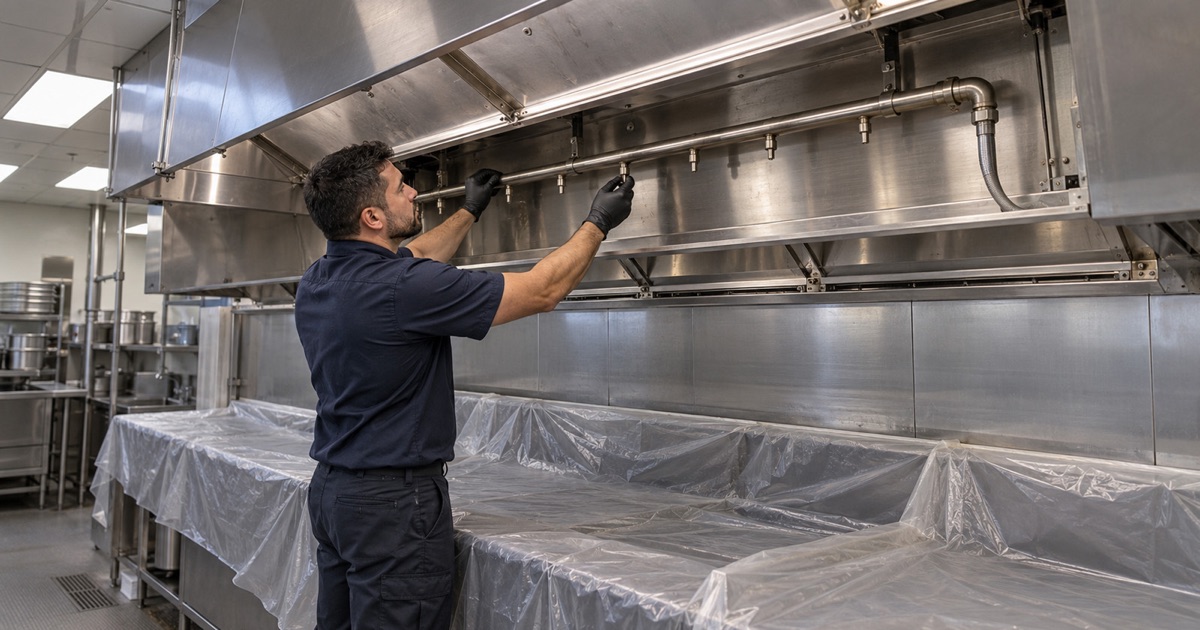
Surfactant Supply, Pumps and Solenoids
The wash cycle depends on detergent actually reaching the plenum, which depends on a surfactant tank that is filled, a pump that is delivering and solenoid valves that are opening when the controller says so. Any of those failing produces a hood that runs its cycle on hot water alone. Nothing in the kitchen indicates this, and the cycle sounds identical from the line, which is why a surfactant tank can sit empty for months in a building that believes its hood is cleaning itself nightly.
Wash Nozzles and Spray Coverage
Nozzles scale up and block, and a partially blocked manifold washes some of the plenum and leaves the rest. Coverage is what the system is actually selling, so descaling the nozzles and confirming the spray pattern is the core of the service. A hood washing three quarters of its plenum on schedule is quietly building a deposit in the other quarter.
Controllers, Cycles and Water Temperature
These systems wash on a timed cycle at a specified temperature, and both drift. A cycle that has been shortened to save time, or a supply that is no longer reaching temperature, reduces the wash to a rinse. We check the sequence against what the system was commissioned to do rather than against whether it appears to run.
Everything Downstream Still Needs Cleaning
Duct, Riser and Fan by Hand
The duct run, the riser and the rooftop fan are cleaned manually on the same basis as any other system, because nothing about a water-wash hood changes what happens beyond it. This is the work most often skipped on these installations, and it is the part that carries the fire risk. The wash cycle does not extend past the plenum, whatever the sales literature implied.
Why the Paperwork Often Looks Fine
A building with a self-cleaning hood frequently has cleaning records that describe the wash system being serviced and nothing about the duct. Read quickly, that reads as a maintained kitchen. Read by a fire inspector who asks when the riser was last opened, it does not. We separate the two on the report so the distinction is visible.
Pollution Control Units and Their Own Intervals
Where a system includes a pollution control unit, ultraviolet lamps or electrostatic precipitator cells, each carries its own maintenance interval on top of everything else — media and MERV-rated filters, lamp replacement, and cell cleaning. Recirculating and ventless systems are stricter again. These are the components most likely to be discovered mid-service rather than declared up front, because they sit inside the unit where nobody has looked and they rarely appear on the schedule the building inherited with the equipment.
Where These Systems Are and Who Owns Them
Institutional and Multi-Tenant Buildings
Water-wash and pollution control equipment tends to be specified in buildings where a conventional rooftop discharge is difficult or unwelcome: enclosed malls, hotels, hospitals and campus dining. Those are also buildings where the kitchen operator and the equipment owner are different parties, which is how a service obligation ends up belonging to nobody in particular.
Handover, Records and Missing Documentation
We frequently arrive at a system whose commissioning documents left the building with a previous manager, so nobody knows the intended cycle, the surfactant specification or when the cells were last serviced. Establishing that from the equipment itself is part of the first visit. It is worth doing once properly rather than guessing every year, and the findings become the baseline every later visit is measured against.
Deciding What the System Actually Needs
Not every self-cleaning hood needs the same service, and some are worth simplifying rather than maintaining. Where a wash system has been out of commission for years and the kitchen has been getting by on manual cleaning, we will say so plainly instead of quoting to recommission something the operator may not want back. That is a budget decision rather than a compliance one, and it belongs to you.
- 20+ Years in Orange County
- Overnight & Between Services
- Photographed to Bare Metal