
Irvine Kitchen Hood Cleaning sets kitchen hood cleaning in Westminster by what comes off the wok rather than by the size of the room, because daily high-heat cooking is what decides the interval here. Westminster is the heart of Little Saigon, and its restaurant sector is not simply large — it is technically distinct in a way that changes the schedule rather than the marketing.
Cooking type, not building type, is what drives frequency here. A kitchen running woks daily produces a fine aerosolized oil mist that travels well past the hood and condenses through the duct run, which loads a system in a way a sandwich operation or a flat-top kitchen never approaches. Orange County Fire Authority’s own guidance names stir frying as a reason to clean more often than a baseline interval.
That means a great many kitchens in this city sit further up the frequency table than their floor area would suggest. Saying so plainly is more useful than quoting a citywide default, and it is the single most important thing a contractor working here has to understand. Everything else about the work follows from getting the band right.
Daily Wok Cooking and What It Does
What High-Heat Cooking Puts Into a System
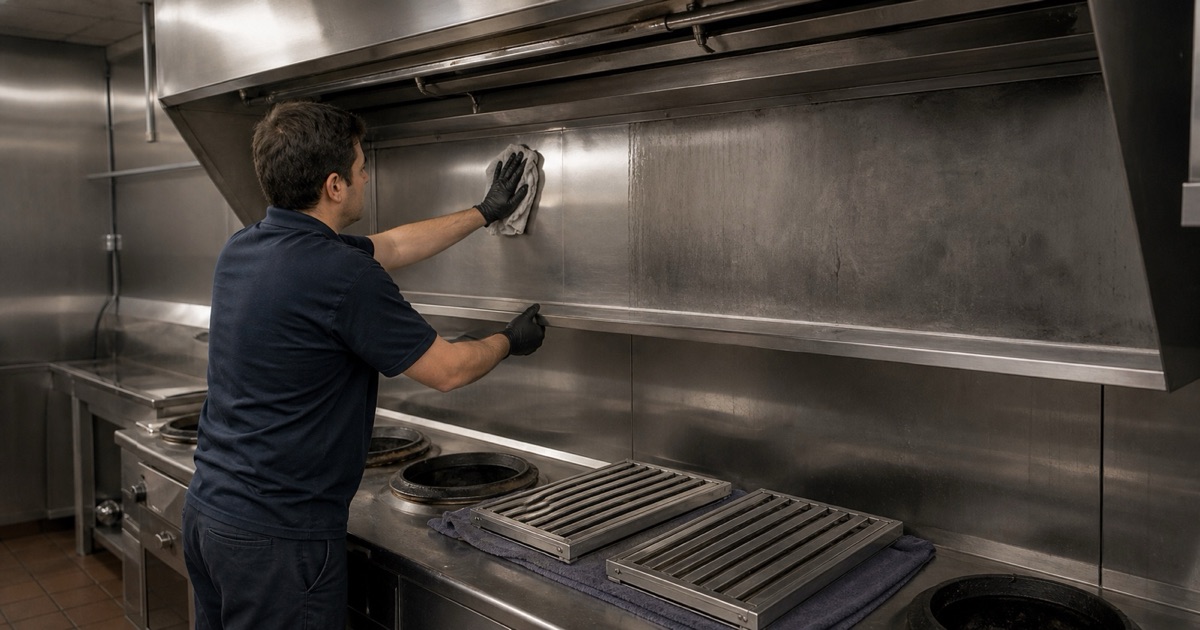
A wok line runs at high heat with oil in constant motion, and what leaves the pan is a fine mist rather than heavy droplets. That mist stays airborne longer, travels further along a duct before condensing, and deposits in sections a conventional kitchen would barely load. The plenum and the first run of duct take the worst of it.
We measure depth at defined points rather than estimating from the hood face, because on a wok kitchen the hood is frequently the least informative place to look. The reading further along the run is what actually decides the interval. A hood that looks acceptable above a wok line is not evidence of anything.
Where That Places a Kitchen on the Table
The fire code bands cooking volume: monthly for solid fuel, quarterly for high-volume operations including wok cooking, semi-annually for moderate volume and annually for genuinely low-volume kitchens. OCFA Guideline D-02 names wok cooking in its high-volume band explicitly.
A kitchen running woks through every service is therefore not a semi-annual account, whatever a previous contractor may have scheduled it as. We say that plainly and back it with a measurement rather than an assertion, because the operator is entitled to see the evidence rather than take the recommendation on trust. Being told to buy more frequent service without being shown why is a fair thing to be suspicious of.
Density Along the Commercial Corridors
The city’s restaurant kitchens concentrate heavily along its main commercial avenues and inside the plaza-style centers that line them, including a large enclosed retail and food complex anchoring the district. Many are small units in multi-tenant buildings with shared roof planes and equipment sitting close together.
We identify each fan against its unit rather than inferring from position, because on a crowded roof plane that mistake is easy to make and expensive to correct. Containment under one tenant’s fan does nothing for the one beside it either, and both get checked separately. On a crowded plaza roof that is a real risk rather than a theoretical one.
Looking for kitchen hood cleaning closer to Stanton? See Kitchen Hood Cleaning in Stanton.
Working in a Dense Restaurant District
Small Units and Compressed Windows
These are mostly independently owned kitchens operating on thin margins with limited capacity to absorb a lost evening. The person deciding on the work is very often the person cooking, and a night without service is a real cost rather than a scheduling inconvenience.
We work overnight and between services, agree the window before quoting, and leave the line wiped down and the floor dry before the first prep shift arrives. That is a basic courtesy and it is also the reason independent operators stay with a contractor rather than re-tendering annually. Reliability on the schedule matters more to a small operator than a marginal price difference.
Shared Buildings and Neighboring Tenants
In plaza-style centers a crew working on one unit is working above and beside several others, and noise, staging and access all affect neighbors who did not order the work. Center management generally controls the roof and the permitted hours rather than any individual tenant.
We agree access once with management and work within it, which means individual tenants are not renegotiating each time. It also makes coordinated servicing across several units in one night possible, which costs each of them less than separate mobilizations would. Several tenants sharing one night’s setup is the cheapest arrangement available to any of them.
Language, Documentation and Being Understood
A compliance record is only useful if the person holding it can use it, and in a district where many operators run their businesses in a second language, a report full of unexplained code citations is not a service. Clear documentation of what was cleaned, what was measured and what could not be reached matters more than technical density.
We write reports to be understood by the person who paid for them as well as by an inspector. That is not a simplification of the content — the measurements and the exceptions are all there — it is a decision about how they are presented. A record the operator cannot read is a record that will not be produced when it matters.
Producing it on request is the entire point of keeping it. An unread record and no record are worth the same on the day somebody asks.
Interval, Authority and Practical Handling
Orange County Fire Authority
Westminster is an OCFA member city and does not run its own fire department, so plan review, inspection and the Guideline D-02 banding all run through the county authority. Records are written to be read by OCFA rather than a municipal fire prevention bureau.
Environmental health sits with Orange County Health Care Agency, which posts a pass or closure notification rather than an A, B or C card. Any material promising to protect a letter grade in this city was written for a different county and describes something that does not happen here.
Grease and Wastewater Through a Special District
Fats, oils and grease requirements here run through a sanitary district rather than the city, and that district’s boundary does not match the city boundary. It is a genuinely easy thing to get wrong, and the neighboring city answers to a different body entirely.
We establish it from the address rather than by pattern. Wash water and degreaser are captured at source rather than sent toward a floor drain, which on a high-output wok kitchen matters more than it does almost anywhere else in this service area.
What Each Visit Leaves Behind
Every cleaning produces measured grease depth as a number, photographs filed by area of the system, and a written list of anything that could not be reached. On a high-frequency kitchen a run of readings across visits is the clearest possible evidence of whether an interval is right.
We keep those records and reissue them on request indefinitely. For an operator who may be asked about their cleaning history years later by an insurer or a buyer, a documented series is worth considerably more than a folder of invoices.
Systems, Access and What Varies Between Units
Small Units and Short Runs
Most kitchens here occupy compact units with correspondingly short duct runs and rooftop equipment close above. The systems themselves are usually simpler than a large suburban restaurant’s, which makes the cleaning quicker once a crew is set up and working.
That simplicity is offset by the density of the district. Staging a truck, running hose and working through the night in a plaza with many neighbors takes more arranging than a freestanding pad restaurant ever does, and access is what sets the timing rather than system length.
Enclosed and Multi-Level Retail
Part of the district’s cooking sits inside enclosed retail with food service below the main level, which changes the exhaust arrangement substantially. Runs travel further and climb, and access openings along them matter far more than they do on a single-story unit.
We map the accessible sections before quoting rather than after, because a run that climbs through a structure is exactly where sections get reported as unreachable. Establishing that early means the quote covers what will actually be done. Discovering it afterwards turns a fixed price into a variation nobody budgeted for. Those become listed access panel quotes rather than a recurring exception on every future report.
Equipment That Predates the Current Tenant
In a district with long-established commercial buildings, exhaust systems frequently predate the operator using them, sometimes by decades. An incoming tenant inherits whatever is above the ceiling along with the lease, usually with no documentation of when it was last opened.
An inspection at handover establishes the actual condition and what it will cost to bring the system to a cleanable state. It is inexpensive against a lease and it is the one piece of due diligence on a kitchen that almost nobody performs in time to use it.
- 20+ Years in Orange County
- Overnight & Between Services
- Photographed to Bare Metal










